

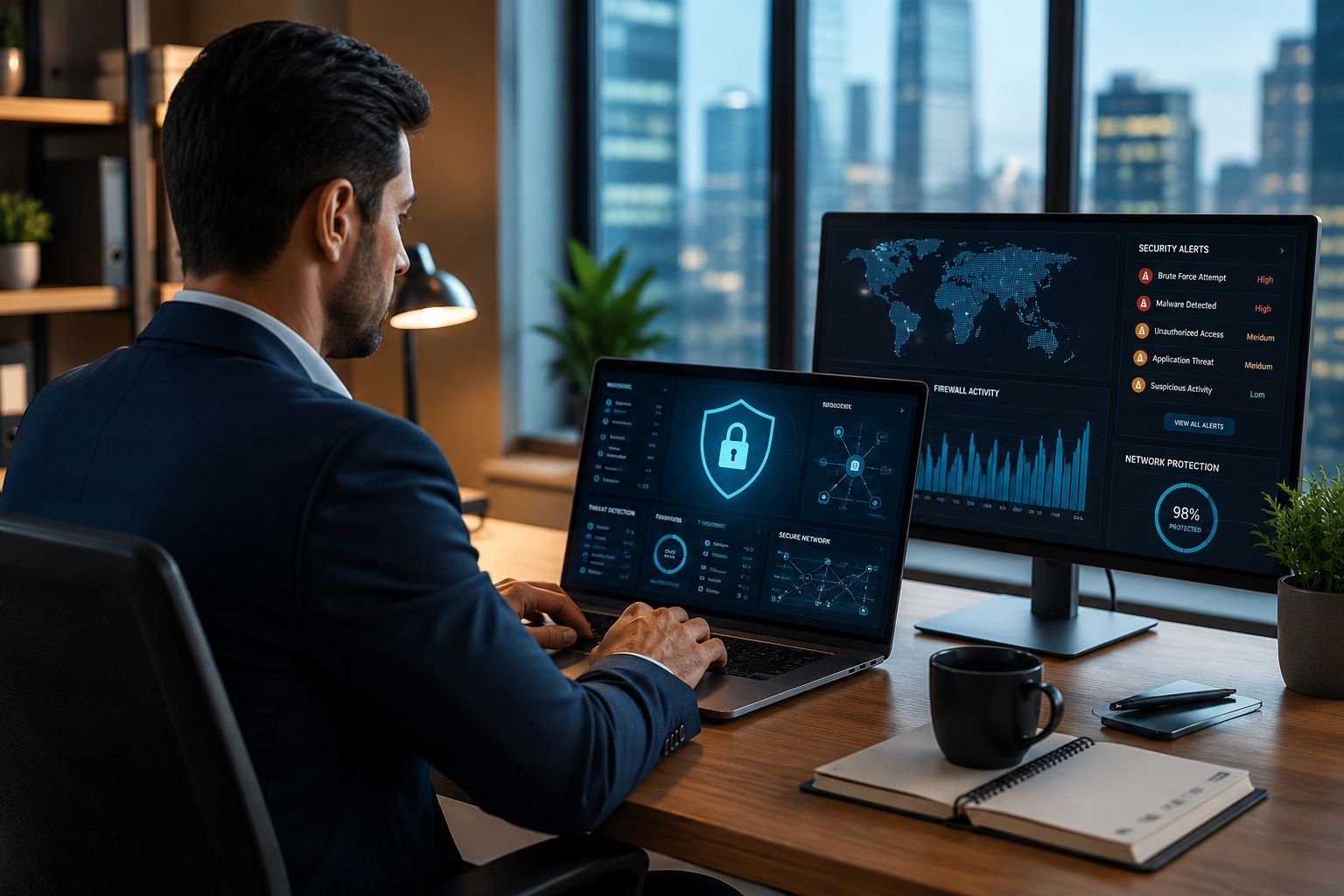
PROTECT YOUR BUSINESS BEFORE IT'S TOO LATE
If you run a small business, you might assume cybercriminals are only after Fortune 500 companies. That assumption is costing businesses like yours millions of dollars every year — and the threat is growing faster than most owners realize.
According to Verizon’s 2026 Data Breach Investigations Report, 43% of all cyberattacks now specifically target small businesses. The reason is simple: small businesses hold valuable data but typically invest far less in security, making them easier targets. And the consequences are devastating — 60% of small businesses that suffer a breach close permanently within six months.
The good news? You don’t need a massive IT budget or a dedicated security team to stay protected. This guide covers 9 proven cybersecurity solutions for small business that are practical, affordable, and effective in 2026 — so you can protect your company before attackers find a way in.
WHY SMALL BUSINESSES ARE PRIME TARGETS FOR CYBER ATTACKS
Cybercriminals are opportunistic — they go where defenses are weakest, and small businesses are increasingly that target. Unlike large corporations with dedicated security teams and enterprise-grade tools, most small businesses operate with limited IT resources, outdated software, and employees who haven’t received formal security training. This is exactly why investing in the right cybersecurity solutions for small business is no longer optional — it’s survival.
According to PreVeil’s 2026 research, small businesses are three times more likely to be targeted by cybercriminals than larger organizations. And with 47% of businesses with fewer than 50 employees allocating zero cybersecurity budget, it’s easy to see why attackers treat SMBs as low-risk, high-reward targets.
The reality is simple: attackers are not just targeting big corporations anymore. Without proper cybersecurity solutions for small business in place, your company’s data, finances, and reputation are exposed every single day.
THE REAL COST OF A CYBERATTACK ON A SMALL BUSINESS
The financial damage from a cyberattack goes far beyond immediate repair costs. IBM’s 2026 Cost of a Data Breach report puts the average breach cost for businesses with fewer than 500 employees at $3.31 million. Even at the lower end, a typical SMB incident runs between $120,000 and $1.24 million — an existential shock for most small companies that haven’t invested in proper cybersecurity solutions for small business.
Beyond the financial hit, 43% of businesses that experience a breach lose existing customers, according to Hiscox’s Cyber Readiness Report. Reputation damage can outlast the financial recovery by years. Employee productivity drops, legal fees pile up, and regulatory fines can follow — costs that never appear in the initial breach estimate.
The math is clear: investing in cybersecurity solutions for small business now is 50 to 60 times cheaper than recovering from a breach later. Every day without protection is a day your business is running an unnecessary risk.
9 ESSENTIAL CYBERSECURITY SOLUTIONS FOR SMALL BUSINESS
You don’t need to implement everything at once. Start with the solutions that address your highest risks, then build from there. Here are nine proven strategies that provide the strongest protection for small businesses in 2026.
1. MULTI-FACTOR AUTHENTICATION (MFA)
Multi-Factor Authentication (MFA) is the single most impactful security control any small business can implement today. By requiring a second form of verification beyond a password, MFA blocks over 99% of automated credential attacks, according to CISA (Cybersecurity and Infrastructure Security Agency).
Enable MFA immediately on all business email accounts, cloud services, banking portals, and any system that stores sensitive customer or financial data. Microsoft Authenticator and Google Authenticator are free, easy to deploy, and work across virtually every major platform.
2. ENDPOINT PROTECTION AND ANTIVIRUS SOFTWARE
Every device that connects to your business network — laptops, desktops, and mobile phones — is a potential entry point for attackers. Modern endpoint protection goes beyond traditional antivirus software to include behavioral analysis, ransomware protection, and real-time threat detection.
Solutions like Microsoft Defender for Business and CrowdStrike Falcon Go bring enterprise-grade endpoint security to small businesses at an accessible price point. For businesses using Microsoft 365 Business Premium, endpoint protection is already included — making it one of the most cost-efficient cybersecurity options for small business owners.
3. EMAIL SECURITY AND ANTI-PHISHING FILTERS
Phishing attacks are the leading cause of small business data breaches, initiating between 80% and 95% of all human-related security incidents, according to Comcast Business Cybersecurity research. Attackers use fake emails to steal login credentials, install malware, or trick employees into transferring funds.
Protecting your email requires two layers: technical controls and employee awareness. On the technical side, configure SPF, DKIM, and DMARC authentication protocols on your business domain — the FTC recommends all three to prevent attackers from impersonating your email address. Pair these with an advanced email filtering solution to block suspicious messages before they reach your team’s inboxes.
4. DATA BACKUP USING THE 3-2-1 STRATEGY
A reliable backup strategy is your last line of defense against ransomware. If attackers encrypt your data and demand payment, a clean backup means you can restore operations without paying a ransom. The 3-2-1 backup rule is the industry standard: maintain three copies of your data, stored on two different media types, with one copy kept offsite or in the cloud.
Implementing a 3-2-1 backup strategy costs under $500 per year for most small businesses and completely eliminates an attacker’s ransomware leverage. Automated cloud backup services like Backblaze, Acronis, or Microsoft Azure Backup make this straightforward to deploy without technical expertise.
5. FIREWALL AND NETWORK SECURITY FOR SMALL BUSINESS
A properly configured firewall controls what traffic enters and leaves your business network, blocking unauthorized access before it reaches your systems. Network security for small business should also include separating your guest Wi-Fi from your internal business network — a simple configuration change that prevents visitors or compromised devices from accessing sensitive data.
For businesses with remote or hybrid teams, a Virtual Private Network (VPN) encrypts internet traffic for employees working outside the office. This is especially critical when staff connect via public Wi-Fi at coffee shops, hotels, or airports.
6. EMPLOYEE CYBERSECURITY AWARENESS TRAINING
Your employees are both your greatest vulnerability and your strongest defense. According to the U.S. Small Business Administration, employees and work-related communications are the leading cause of small business data breaches. A single click on a malicious email link can compromise your entire network.
Regular cybersecurity awareness training teaches your team to recognize phishing emails, use strong passwords, handle sensitive data properly, and report suspicious activity immediately. Even a quarterly 30-minute training session significantly reduces the risk of a human-error breach. CISA offers free training resources specifically designed for small business employees.
7. PASSWORD MANAGEMENT
Weak and reused passwords remain one of the most exploited vulnerabilities in small business cybersecurity. A password manager solves this problem by generating unique, complex passwords for every account and storing them securely — eliminating the need for employees to remember dozens of credentials.
Business-grade password managers like 1Password Teams or Bitwarden Business allow you to manage credentials centrally, enforce strong password policies, and immediately revoke access when an employee leaves. This level of credential control is one of the highest-return, lowest-cost cybersecurity investments available to small businesses.
8. CLOUD SECURITY SOLUTIONS
Migrating business data and applications to reputable cloud platforms often provides stronger security than on-premise servers — particularly for small businesses without dedicated IT staff. Leading cloud providers like Microsoft Azure, Google Workspace, and AWS invest billions annually in security infrastructure that no small business could replicate independently.
Cloud security for small business should include access controls (who can view and edit which data), activity monitoring, and regular permission reviews. Ensure that sensitive business data is not stored in personal cloud accounts, and configure sharing settings to restrict external access by default.
9. MANAGED SECURITY SERVICE PROVIDER (MSSP)
For small businesses that lack internal IT resources, a Managed Security Service Provider (MSSP) delivers comprehensive cybersecurity protection through an outsourced model. A quality MSSP provides 24/7 network monitoring, real-time threat detection, incident response, and regular security reporting — capabilities that would cost significantly more to build in-house.
Partnering with an MSSP means you have a team of certified security professionals protecting your business around the clock, without the cost of hiring full-time staff. This model is particularly valuable for small businesses in industries that handle sensitive customer data, including healthcare, finance, legal, and retail.
HOW MUCH DOES CYBERSECURITY COST FOR A SMALL BUSINESS?
Cybersecurity costs vary based on business size, industry, and the level of protection required. However, the most critical protections — MFA, password management, employee training, and basic backup — can be implemented for under $1,000 per year for most small businesses.
Consider this perspective: StrongDM’s 2026 research found that 47% of businesses with fewer than 50 employees allocate zero cybersecurity budget. Yet the average cyberattack costs an SMB $120,000 at the low end. Investing $3,000 to $10,000 annually in cybersecurity is not an expense — it is insurance against a loss that could permanently close your business.
CONCLUSION
Cyber threats are not slowing down — and small businesses are firmly in the crosshairs. The statistics are clear: 43% of attacks target SMBs, 60% of breached businesses close within six months, and the average incident costs far more than any annual investment in cybersecurity solutions for small business.
The nine cybersecurity solutions for small business covered in this guide give you a practical, layered security framework that scales with your business. Start with MFA and email security, build in backup and employee training, and consider an MSSP partnership as your protection matures.
Implementing the right cybersecurity solutions for small business today can save your company from devastating losses tomorrow. Don’t wait for a breach to act — the cost of prevention is always less than the cost of recovery.
No Comments