

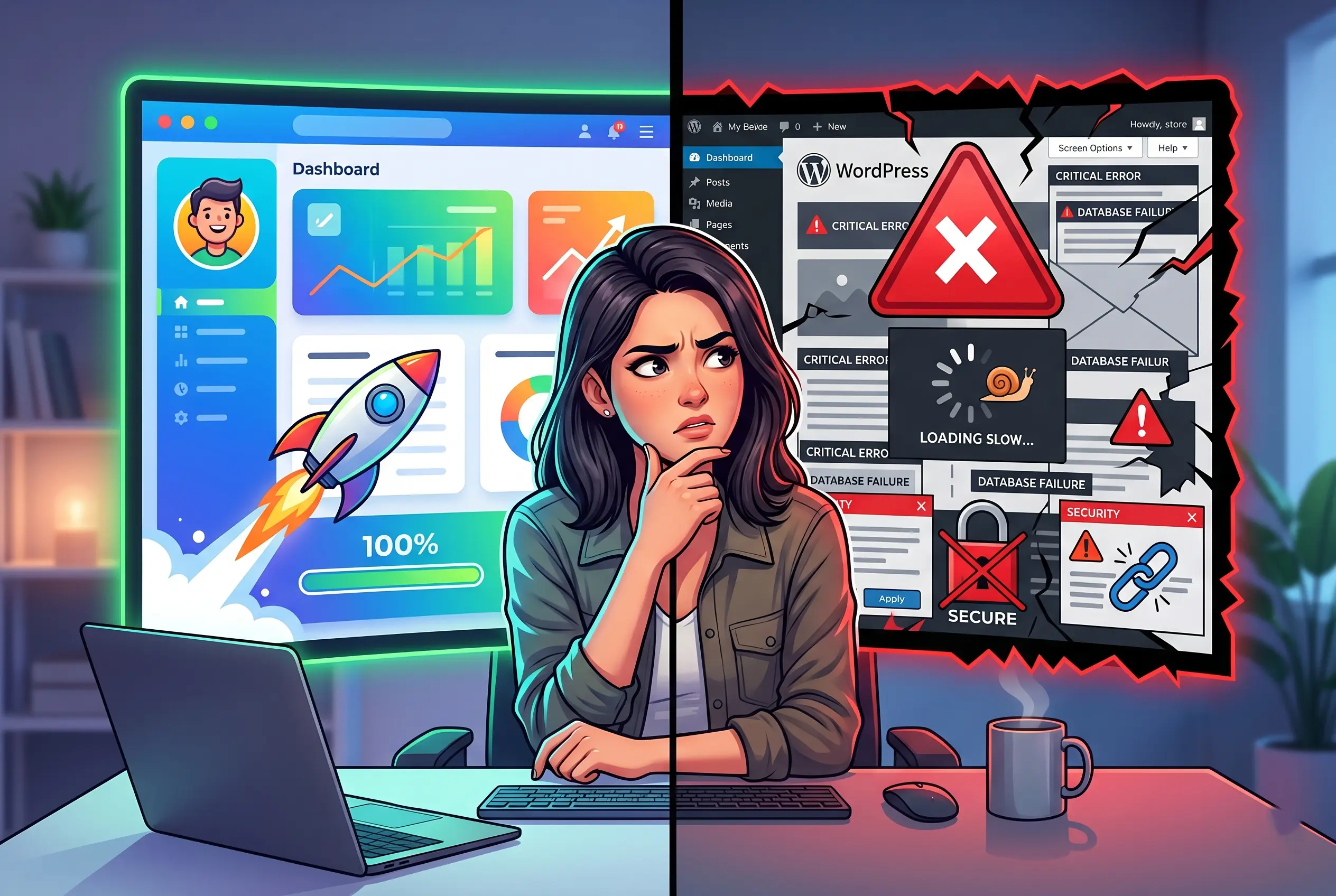
WordPress powers over 40% of websites worldwide, making it the go-to CMS for businesses, bloggers, and developers. However, despite its flexibility, it comes with several drawbacks that can affect site performance, security, and scalability. Understanding these disadvantages helps businesses make informed decisions and plan for optimization or professional support.
Critical Security Vulnerabilities
WordPress is a frequent target for hackers due to its popularity. Common risks include:
Conclusion
WordPress offers flexibility and a vast ecosystem but comes with security, performance, plugin, and scalability challenges. By understanding these disadvantages, implementing best practices, and investing in professional support or optimization services, businesses can maintain a secure, fast, and reliable WordPress website.
Action Steps:
- Audit your existing plugins and themes.
- Implement security and caching tools.
- Regularly monitor performance and updates.
- Consider alternatives for enterprise-scale projects.
- Limit plugin use to essential functionality.
- Test new plugins on staging environments first.
- Hire professional WordPress developers for complex setups.
Maintenance
and Hidden Costs
Though WordPress is free, maintaining a professional site has costs:
- Managed Hosting & Security Services: Monthly fees are necessary for reliable uptime and protection.
- Premium Plugins and Themes: Advanced features often require paid licenses.
- Technical Expertise: Complex issues may require professional developers, especially for enterprise sites.
Cost Management Recommendations:
- Budget for ongoing support.
- Use high-quality themes/plugins to reduce maintenance complexity.
- Outsource optimization and security monitoring if internal expertise is limited.
Scalability Limitations
WordPress can struggle with enterprise-level demands:
- High-traffic sites may require server upgrades or caching strategies.
- Large databases can slow query performance.
- Plugin dependency increases complexity as your site grows.
Decision Framework: For large enterprise websites, consider headless CMS or custom platforms if performance and scalability are critical.
Comparison:
WordPress vs Alternatives
| Feature | WordPress | HTML / Static Sites | Modern CMS (Headless) |
| Speed | Moderate, needs optimization | Fast, minimal overhead | Fast, API-driven |
| Security | Vulnerable to attacks if unmanaged | Low, less dynamic | Strong with modern frameworks |
| Scalability | Medium | High, static | High, scalable APIs |
| Customization | High but plugin-dependent | Low, manual coding | High with APIs & modular design |
Conclusion
WordPress offers flexibility and a vast ecosystem but comes with security, performance, plugin, and scalability challenges. By understanding these disadvantages, implementing best practices, and investing in professional support or optimization services, businesses can maintain a secure, fast, and reliable WordPress website.
Action Steps:
- Audit your existing plugins and themes.
- Implement security and caching tools.
- Regularly monitor performance and updates.
- Consider alternatives for enterprise-scale projects.
- Code Bloat: Heavy themes and multiple plugins increase load times.
- Hosting Limitations: Shared hosting can throttle resources during traffic spikes.
- Database Inefficiency: Accumulated post revisions and spam slow queries.
- Media Management: Large, unoptimized images impact page speed.
- Missing Caching: Without tools like WP Rocket, every page loads via fresh database queries.
Step-by-Step
Speed Optimization:
- Minimize plugins and choose lightweight themes.
- Optimize images using WebP or compression tools.
- Implement caching and CDN solutions.
- Clean database regularly with optimization plugins.
Plugin and
Theme Conflicts
While plugins extend functionality, they often cause technical challenges:
- Compatibility Issues: Conflicts between plugins or themes can crash a site.
- Design Restrictions: Prebuilt themes may not support custom layouts without coding.
- Inconsistent Support: Free plugins often lack robust documentation.
Tips to Reduce Plugin Conflicts:
- Limit plugin use to essential functionality.
- Test new plugins on staging environments first.
- Hire professional WordPress developers for complex setups.
Maintenance
and Hidden Costs
Though WordPress is free, maintaining a professional site has costs:
- Managed Hosting & Security Services: Monthly fees are necessary for reliable uptime and protection.
- Premium Plugins and Themes: Advanced features often require paid licenses.
- Technical Expertise: Complex issues may require professional developers, especially for enterprise sites.
Cost Management Recommendations:
- Budget for ongoing support.
- Use high-quality themes/plugins to reduce maintenance complexity.
- Outsource optimization and security monitoring if internal expertise is limited.
Scalability Limitations
WordPress can struggle with enterprise-level demands:
- High-traffic sites may require server upgrades or caching strategies.
- Large databases can slow query performance.
- Plugin dependency increases complexity as your site grows.
Decision Framework: For large enterprise websites, consider headless CMS or custom platforms if performance and scalability are critical.
Comparison:
WordPress vs Alternatives
| Feature | WordPress | HTML / Static Sites | Modern CMS (Headless) |
| Speed | Moderate, needs optimization | Fast, minimal overhead | Fast, API-driven |
| Security | Vulnerable to attacks if unmanaged | Low, less dynamic | Strong with modern frameworks |
| Scalability | Medium | High, static | High, scalable APIs |
| Customization | High but plugin-dependent | Low, manual coding | High with APIs & modular design |
Conclusion
WordPress offers flexibility and a vast ecosystem but comes with security, performance, plugin, and scalability challenges. By understanding these disadvantages, implementing best practices, and investing in professional support or optimization services, businesses can maintain a secure, fast, and reliable WordPress website.
Action Steps:
- Audit your existing plugins and themes.
- Implement security and caching tools.
- Regularly monitor performance and updates.
- Consider alternatives for enterprise-scale projects.
- Outdated Plugins and Themes: Vulnerable or abandoned plugins/themes are prime entry points for attacks.
- Brute Force Attacks: Default login pages without strong passwords are easily compromised.
- Weak Configurations: Using “admin” usernames or default database prefixes increases exposure.
How to Mitigate
Security Risks:
- Regularly update core WordPress, plugins, and themes.
- Use security plugins like Wordfence or Sucuri.
- Implement strong passwords and two-factor authentication.
- Harden your database and server configurations.
Performance and
Speed Drawbacks
Slow websites hurt user experience and SEO. Key causes include:
- Code Bloat: Heavy themes and multiple plugins increase load times.
- Hosting Limitations: Shared hosting can throttle resources during traffic spikes.
- Database Inefficiency: Accumulated post revisions and spam slow queries.
- Media Management: Large, unoptimized images impact page speed.
- Missing Caching: Without tools like WP Rocket, every page loads via fresh database queries.
Step-by-Step
Speed Optimization:
- Minimize plugins and choose lightweight themes.
- Optimize images using WebP or compression tools.
- Implement caching and CDN solutions.
- Clean database regularly with optimization plugins.
Plugin and
Theme Conflicts
While plugins extend functionality, they often cause technical challenges:
- Compatibility Issues: Conflicts between plugins or themes can crash a site.
- Design Restrictions: Prebuilt themes may not support custom layouts without coding.
- Inconsistent Support: Free plugins often lack robust documentation.
Tips to Reduce Plugin Conflicts:
- Limit plugin use to essential functionality.
- Test new plugins on staging environments first.
- Hire professional WordPress developers for complex setups.
Maintenance
and Hidden Costs
Though WordPress is free, maintaining a professional site has costs:
- Managed Hosting & Security Services: Monthly fees are necessary for reliable uptime and protection.
- Premium Plugins and Themes: Advanced features often require paid licenses.
- Technical Expertise: Complex issues may require professional developers, especially for enterprise sites.
Cost Management Recommendations:
- Budget for ongoing support.
- Use high-quality themes/plugins to reduce maintenance complexity.
- Outsource optimization and security monitoring if internal expertise is limited.
Scalability Limitations
WordPress can struggle with enterprise-level demands:
- High-traffic sites may require server upgrades or caching strategies.
- Large databases can slow query performance.
- Plugin dependency increases complexity as your site grows.
Decision Framework: For large enterprise websites, consider headless CMS or custom platforms if performance and scalability are critical.
Comparison:
WordPress vs Alternatives
| Feature | WordPress | HTML / Static Sites | Modern CMS (Headless) |
| Speed | Moderate, needs optimization | Fast, minimal overhead | Fast, API-driven |
| Security | Vulnerable to attacks if unmanaged | Low, less dynamic | Strong with modern frameworks |
| Scalability | Medium | High, static | High, scalable APIs |
| Customization | High but plugin-dependent | Low, manual coding | High with APIs & modular design |
Conclusion
WordPress offers flexibility and a vast ecosystem but comes with security, performance, plugin, and scalability challenges. By understanding these disadvantages, implementing best practices, and investing in professional support or optimization services, businesses can maintain a secure, fast, and reliable WordPress website.
Action Steps:
- Audit your existing plugins and themes.
- Implement security and caching tools.
- Regularly monitor performance and updates.
- Consider alternatives for enterprise-scale projects.
- Limit plugin use to essential functionality.
- Test new plugins on staging environments first.
- Hire professional WordPress developers for complex setups.
Maintenance
and Hidden Costs
Though WordPress is free, maintaining a professional site has costs:
- Managed Hosting & Security Services: Monthly fees are necessary for reliable uptime and protection.
- Premium Plugins and Themes: Advanced features often require paid licenses.
- Technical Expertise: Complex issues may require professional developers, especially for enterprise sites.
Cost Management Recommendations:
- Budget for ongoing support.
- Use high-quality themes/plugins to reduce maintenance complexity.
- Outsource optimization and security monitoring if internal expertise is limited.
Scalability Limitations
WordPress can struggle with enterprise-level demands:
- High-traffic sites may require server upgrades or caching strategies.
- Large databases can slow query performance.
- Plugin dependency increases complexity as your site grows.
Decision Framework: For large enterprise websites, consider headless CMS or custom platforms if performance and scalability are critical.
Comparison:
WordPress vs Alternatives
| Feature | WordPress | HTML / Static Sites | Modern CMS (Headless) |
| Speed | Moderate, needs optimization | Fast, minimal overhead | Fast, API-driven |
| Security | Vulnerable to attacks if unmanaged | Low, less dynamic | Strong with modern frameworks |
| Scalability | Medium | High, static | High, scalable APIs |
| Customization | High but plugin-dependent | Low, manual coding | High with APIs & modular design |
Conclusion
WordPress offers flexibility and a vast ecosystem but comes with security, performance, plugin, and scalability challenges. By understanding these disadvantages, implementing best practices, and investing in professional support or optimization services, businesses can maintain a secure, fast, and reliable WordPress website.
Action Steps:
- Audit your existing plugins and themes.
- Implement security and caching tools.
- Regularly monitor performance and updates.
- Consider alternatives for enterprise-scale projects.
- Outdated Plugins and Themes: Vulnerable or abandoned plugins/themes are prime entry points for attacks.
- Brute Force Attacks: Default login pages without strong passwords are easily compromised.
- Weak Configurations: Using “admin” usernames or default database prefixes increases exposure.
How to Mitigate
Security Risks:
- Regularly update core WordPress, plugins, and themes.
- Use security plugins like Wordfence or Sucuri.
- Implement strong passwords and two-factor authentication.
- Harden your database and server configurations.
Performance and
Speed Drawbacks
Slow websites hurt user experience and SEO. Key causes include:
- Code Bloat: Heavy themes and multiple plugins increase load times.
- Hosting Limitations: Shared hosting can throttle resources during traffic spikes.
- Database Inefficiency: Accumulated post revisions and spam slow queries.
- Media Management: Large, unoptimized images impact page speed.
- Missing Caching: Without tools like WP Rocket, every page loads via fresh database queries.
Step-by-Step
Speed Optimization:
- Minimize plugins and choose lightweight themes.
- Optimize images using WebP or compression tools.
- Implement caching and CDN solutions.
- Clean database regularly with optimization plugins.
Plugin and
Theme Conflicts
While plugins extend functionality, they often cause technical challenges:
- Compatibility Issues: Conflicts between plugins or themes can crash a site.
- Design Restrictions: Prebuilt themes may not support custom layouts without coding.
- Inconsistent Support: Free plugins often lack robust documentation.
Tips to Reduce Plugin Conflicts:
- Limit plugin use to essential functionality.
- Test new plugins on staging environments first.
- Hire professional WordPress developers for complex setups.
Maintenance
and Hidden Costs
Though WordPress is free, maintaining a professional site has costs:
- Managed Hosting & Security Services: Monthly fees are necessary for reliable uptime and protection.
- Premium Plugins and Themes: Advanced features often require paid licenses.
- Technical Expertise: Complex issues may require professional developers, especially for enterprise sites.
Cost Management Recommendations:
- Budget for ongoing support.
- Use high-quality themes/plugins to reduce maintenance complexity.
- Outsource optimization and security monitoring if internal expertise is limited.
Scalability Limitations
WordPress can struggle with enterprise-level demands:
- High-traffic sites may require server upgrades or caching strategies.
- Large databases can slow query performance.
- Plugin dependency increases complexity as your site grows.
Decision Framework: For large enterprise websites, consider headless CMS or custom platforms if performance and scalability are critical.
Comparison:
WordPress vs Alternatives
| Feature | WordPress | HTML / Static Sites | Modern CMS (Headless) |
| Speed | Moderate, needs optimization | Fast, minimal overhead | Fast, API-driven |
| Security | Vulnerable to attacks if unmanaged | Low, less dynamic | Strong with modern frameworks |
| Scalability | Medium | High, static | High, scalable APIs |
| Customization | High but plugin-dependent | Low, manual coding | High with APIs & modular design |
Conclusion
WordPress offers flexibility and a vast ecosystem but comes with security, performance, plugin, and scalability challenges. By understanding these disadvantages, implementing best practices, and investing in professional support or optimization services, businesses can maintain a secure, fast, and reliable WordPress website.
Action Steps:
- Audit your existing plugins and themes.
- Implement security and caching tools.
- Regularly monitor performance and updates.
- Consider alternatives for enterprise-scale projects.
- Code Bloat: Heavy themes and multiple plugins increase load times.
- Hosting Limitations: Shared hosting can throttle resources during traffic spikes.
- Database Inefficiency: Accumulated post revisions and spam slow queries.
- Media Management: Large, unoptimized images impact page speed.
- Missing Caching: Without tools like WP Rocket, every page loads via fresh database queries.
Step-by-Step
Speed Optimization:
- Minimize plugins and choose lightweight themes.
- Optimize images using WebP or compression tools.
- Implement caching and CDN solutions.
- Clean database regularly with optimization plugins.
Plugin and
Theme Conflicts
While plugins extend functionality, they often cause technical challenges:
- Compatibility Issues: Conflicts between plugins or themes can crash a site.
- Design Restrictions: Prebuilt themes may not support custom layouts without coding.
- Inconsistent Support: Free plugins often lack robust documentation.
Tips to Reduce Plugin Conflicts:
- Limit plugin use to essential functionality.
- Test new plugins on staging environments first.
- Hire professional WordPress developers for complex setups.
Maintenance
and Hidden Costs
Though WordPress is free, maintaining a professional site has costs:
- Managed Hosting & Security Services: Monthly fees are necessary for reliable uptime and protection.
- Premium Plugins and Themes: Advanced features often require paid licenses.
- Technical Expertise: Complex issues may require professional developers, especially for enterprise sites.
Cost Management Recommendations:
- Budget for ongoing support.
- Use high-quality themes/plugins to reduce maintenance complexity.
- Outsource optimization and security monitoring if internal expertise is limited.
Scalability Limitations
WordPress can struggle with enterprise-level demands:
- High-traffic sites may require server upgrades or caching strategies.
- Large databases can slow query performance.
- Plugin dependency increases complexity as your site grows.
Decision Framework: For large enterprise websites, consider headless CMS or custom platforms if performance and scalability are critical.
Comparison:
WordPress vs Alternatives
| Feature | WordPress | HTML / Static Sites | Modern CMS (Headless) |
| Speed | Moderate, needs optimization | Fast, minimal overhead | Fast, API-driven |
| Security | Vulnerable to attacks if unmanaged | Low, less dynamic | Strong with modern frameworks |
| Scalability | Medium | High, static | High, scalable APIs |
| Customization | High but plugin-dependent | Low, manual coding | High with APIs & modular design |
Conclusion
WordPress offers flexibility and a vast ecosystem but comes with security, performance, plugin, and scalability challenges. By understanding these disadvantages, implementing best practices, and investing in professional support or optimization services, businesses can maintain a secure, fast, and reliable WordPress website.
Action Steps:
- Audit your existing plugins and themes.
- Implement security and caching tools.
- Regularly monitor performance and updates.
- Consider alternatives for enterprise-scale projects.
- Outdated Plugins and Themes: Vulnerable or abandoned plugins/themes are prime entry points for attacks.
- Brute Force Attacks: Default login pages without strong passwords are easily compromised.
- Weak Configurations: Using “admin” usernames or default database prefixes increases exposure.
How to Mitigate
Security Risks:
- Regularly update core WordPress, plugins, and themes.
- Use security plugins like Wordfence or Sucuri.
- Implement strong passwords and two-factor authentication.
- Harden your database and server configurations.
Performance and
Speed Drawbacks
Slow websites hurt user experience and SEO. Key causes include:
- Code Bloat: Heavy themes and multiple plugins increase load times.
- Hosting Limitations: Shared hosting can throttle resources during traffic spikes.
- Database Inefficiency: Accumulated post revisions and spam slow queries.
- Media Management: Large, unoptimized images impact page speed.
- Missing Caching: Without tools like WP Rocket, every page loads via fresh database queries.
Step-by-Step
Speed Optimization:
- Minimize plugins and choose lightweight themes.
- Optimize images using WebP or compression tools.
- Implement caching and CDN solutions.
- Clean database regularly with optimization plugins.
Plugin and
Theme Conflicts
While plugins extend functionality, they often cause technical challenges:
- Compatibility Issues: Conflicts between plugins or themes can crash a site.
- Design Restrictions: Prebuilt themes may not support custom layouts without coding.
- Inconsistent Support: Free plugins often lack robust documentation.
Tips to Reduce Plugin Conflicts:
- Limit plugin use to essential functionality.
- Test new plugins on staging environments first.
- Hire professional WordPress developers for complex setups.
Maintenance
and Hidden Costs
Though WordPress is free, maintaining a professional site has costs:
- Managed Hosting & Security Services: Monthly fees are necessary for reliable uptime and protection.
- Premium Plugins and Themes: Advanced features often require paid licenses.
- Technical Expertise: Complex issues may require professional developers, especially for enterprise sites.
Cost Management Recommendations:
- Budget for ongoing support.
- Use high-quality themes/plugins to reduce maintenance complexity.
- Outsource optimization and security monitoring if internal expertise is limited.
Scalability Limitations
WordPress can struggle with enterprise-level demands:
- High-traffic sites may require server upgrades or caching strategies.
- Large databases can slow query performance.
- Plugin dependency increases complexity as your site grows.
Decision Framework: For large enterprise websites, consider headless CMS or custom platforms if performance and scalability are critical.
Comparison:
WordPress vs Alternatives
| Feature | WordPress | HTML / Static Sites | Modern CMS (Headless) |
| Speed | Moderate, needs optimization | Fast, minimal overhead | Fast, API-driven |
| Security | Vulnerable to attacks if unmanaged | Low, less dynamic | Strong with modern frameworks |
| Scalability | Medium | High, static | High, scalable APIs |
| Customization | High but plugin-dependent | Low, manual coding | High with APIs & modular design |
Conclusion
WordPress offers flexibility and a vast ecosystem but comes with security, performance, plugin, and scalability challenges. By understanding these disadvantages, implementing best practices, and investing in professional support or optimization services, businesses can maintain a secure, fast, and reliable WordPress website.
Action Steps:
- Audit your existing plugins and themes.
- Implement security and caching tools.
- Regularly monitor performance and updates.
- Consider alternatives for enterprise-scale projects.
- Limit plugin use to essential functionality.
- Test new plugins on staging environments first.
- Hire professional WordPress developers for complex setups.
Maintenance
and Hidden Costs
Though WordPress is free, maintaining a professional site has costs:
- Managed Hosting & Security Services: Monthly fees are necessary for reliable uptime and protection.
- Premium Plugins and Themes: Advanced features often require paid licenses.
- Technical Expertise: Complex issues may require professional developers, especially for enterprise sites.
Cost Management Recommendations:
- Budget for ongoing support.
- Use high-quality themes/plugins to reduce maintenance complexity.
- Outsource optimization and security monitoring if internal expertise is limited.
Scalability Limitations
WordPress can struggle with enterprise-level demands:
- High-traffic sites may require server upgrades or caching strategies.
- Large databases can slow query performance.
- Plugin dependency increases complexity as your site grows.
Decision Framework: For large enterprise websites, consider headless CMS or custom platforms if performance and scalability are critical.
Comparison:
WordPress vs Alternatives
| Feature | WordPress | HTML / Static Sites | Modern CMS (Headless) |
| Speed | Moderate, needs optimization | Fast, minimal overhead | Fast, API-driven |
| Security | Vulnerable to attacks if unmanaged | Low, less dynamic | Strong with modern frameworks |
| Scalability | Medium | High, static | High, scalable APIs |
| Customization | High but plugin-dependent | Low, manual coding | High with APIs & modular design |
Conclusion
WordPress offers flexibility and a vast ecosystem but comes with security, performance, plugin, and scalability challenges. By understanding these disadvantages, implementing best practices, and investing in professional support or optimization services, businesses can maintain a secure, fast, and reliable WordPress website.
Action Steps:
- Audit your existing plugins and themes.
- Implement security and caching tools.
- Regularly monitor performance and updates.
- Consider alternatives for enterprise-scale projects.
- Code Bloat: Heavy themes and multiple plugins increase load times.
- Hosting Limitations: Shared hosting can throttle resources during traffic spikes.
- Database Inefficiency: Accumulated post revisions and spam slow queries.
- Media Management: Large, unoptimized images impact page speed.
- Missing Caching: Without tools like WP Rocket, every page loads via fresh database queries.
Step-by-Step
Speed Optimization:
- Minimize plugins and choose lightweight themes.
- Optimize images using WebP or compression tools.
- Implement caching and CDN solutions.
- Clean database regularly with optimization plugins.
Plugin and
Theme Conflicts
While plugins extend functionality, they often cause technical challenges:
- Compatibility Issues: Conflicts between plugins or themes can crash a site.
- Design Restrictions: Prebuilt themes may not support custom layouts without coding.
- Inconsistent Support: Free plugins often lack robust documentation.
Tips to Reduce Plugin Conflicts:
- Limit plugin use to essential functionality.
- Test new plugins on staging environments first.
- Hire professional WordPress developers for complex setups.
Maintenance
and Hidden Costs
Though WordPress is free, maintaining a professional site has costs:
- Managed Hosting & Security Services: Monthly fees are necessary for reliable uptime and protection.
- Premium Plugins and Themes: Advanced features often require paid licenses.
- Technical Expertise: Complex issues may require professional developers, especially for enterprise sites.
Cost Management Recommendations:
- Budget for ongoing support.
- Use high-quality themes/plugins to reduce maintenance complexity.
- Outsource optimization and security monitoring if internal expertise is limited.
Scalability Limitations
WordPress can struggle with enterprise-level demands:
- High-traffic sites may require server upgrades or caching strategies.
- Large databases can slow query performance.
- Plugin dependency increases complexity as your site grows.
Decision Framework: For large enterprise websites, consider headless CMS or custom platforms if performance and scalability are critical.
Comparison:
WordPress vs Alternatives
| Feature | WordPress | HTML / Static Sites | Modern CMS (Headless) |
| Speed | Moderate, needs optimization | Fast, minimal overhead | Fast, API-driven |
| Security | Vulnerable to attacks if unmanaged | Low, less dynamic | Strong with modern frameworks |
| Scalability | Medium | High, static | High, scalable APIs |
| Customization | High but plugin-dependent | Low, manual coding | High with APIs & modular design |
Conclusion
WordPress offers flexibility and a vast ecosystem but comes with security, performance, plugin, and scalability challenges. By understanding these disadvantages, implementing best practices, and investing in professional support or optimization services, businesses can maintain a secure, fast, and reliable WordPress website.
Action Steps:
- Audit your existing plugins and themes.
- Implement security and caching tools.
- Regularly monitor performance and updates.
- Consider alternatives for enterprise-scale projects.
- Outdated Plugins and Themes: Vulnerable or abandoned plugins/themes are prime entry points for attacks.
- Brute Force Attacks: Default login pages without strong passwords are easily compromised.
- Weak Configurations: Using “admin” usernames or default database prefixes increases exposure.
How to Mitigate
Security Risks:
- Regularly update core WordPress, plugins, and themes.
- Use security plugins like Wordfence or Sucuri.
- Implement strong passwords and two-factor authentication.
- Harden your database and server configurations.
Performance and
Speed Drawbacks
Slow websites hurt user experience and SEO. Key causes include:
- Code Bloat: Heavy themes and multiple plugins increase load times.
- Hosting Limitations: Shared hosting can throttle resources during traffic spikes.
- Database Inefficiency: Accumulated post revisions and spam slow queries.
- Media Management: Large, unoptimized images impact page speed.
- Missing Caching: Without tools like WP Rocket, every page loads via fresh database queries.
Step-by-Step
Speed Optimization:
- Minimize plugins and choose lightweight themes.
- Optimize images using WebP or compression tools.
- Implement caching and CDN solutions.
- Clean database regularly with optimization plugins.
Plugin and
Theme Conflicts
While plugins extend functionality, they often cause technical challenges:
- Compatibility Issues: Conflicts between plugins or themes can crash a site.
- Design Restrictions: Prebuilt themes may not support custom layouts without coding.
- Inconsistent Support: Free plugins often lack robust documentation.
Tips to Reduce Plugin Conflicts:
- Limit plugin use to essential functionality.
- Test new plugins on staging environments first.
- Hire professional WordPress developers for complex setups.
Maintenance
and Hidden Costs
Though WordPress is free, maintaining a professional site has costs:
- Managed Hosting & Security Services: Monthly fees are necessary for reliable uptime and protection.
- Premium Plugins and Themes: Advanced features often require paid licenses.
- Technical Expertise: Complex issues may require professional developers, especially for enterprise sites.
Cost Management Recommendations:
- Budget for ongoing support.
- Use high-quality themes/plugins to reduce maintenance complexity.
- Outsource optimization and security monitoring if internal expertise is limited.
Scalability Limitations
WordPress can struggle with enterprise-level demands:
- High-traffic sites may require server upgrades or caching strategies.
- Large databases can slow query performance.
- Plugin dependency increases complexity as your site grows.
Decision Framework: For large enterprise websites, consider headless CMS or custom platforms if performance and scalability are critical.
Comparison:
WordPress vs Alternatives
| Feature | WordPress | HTML / Static Sites | Modern CMS (Headless) |
| Speed | Moderate, needs optimization | Fast, minimal overhead | Fast, API-driven |
| Security | Vulnerable to attacks if unmanaged | Low, less dynamic | Strong with modern frameworks |
| Scalability | Medium | High, static | High, scalable APIs |
| Customization | High but plugin-dependent | Low, manual coding | High with APIs & modular design |
Conclusion
WordPress offers flexibility and a vast ecosystem but comes with security, performance, plugin, and scalability challenges. By understanding these disadvantages, implementing best practices, and investing in professional support or optimization services, businesses can maintain a secure, fast, and reliable WordPress website.
Action Steps:
- Audit your existing plugins and themes.
- Implement security and caching tools.
- Regularly monitor performance and updates.
- Consider alternatives for enterprise-scale projects.
- Code Bloat: Heavy themes and multiple plugins increase load times.
- Hosting Limitations: Shared hosting can throttle resources during traffic spikes.
- Database Inefficiency: Accumulated post revisions and spam slow queries.
- Media Management: Large, unoptimized images impact page speed.
- Missing Caching: Without tools like WP Rocket, every page loads via fresh database queries.
Step-by-Step
Speed Optimization:
- Minimize plugins and choose lightweight themes.
- Optimize images using WebP or compression tools.
- Implement caching and CDN solutions.
- Clean database regularly with optimization plugins.
Plugin and
Theme Conflicts
While plugins extend functionality, they often cause technical challenges:
- Compatibility Issues: Conflicts between plugins or themes can crash a site.
- Design Restrictions: Prebuilt themes may not support custom layouts without coding.
- Inconsistent Support: Free plugins often lack robust documentation.
Tips to Reduce Plugin Conflicts:
- Limit plugin use to essential functionality.
- Test new plugins on staging environments first.
- Hire professional WordPress developers for complex setups.
Maintenance
and Hidden Costs
Though WordPress is free, maintaining a professional site has costs:
- Managed Hosting & Security Services: Monthly fees are necessary for reliable uptime and protection.
- Premium Plugins and Themes: Advanced features often require paid licenses.
- Technical Expertise: Complex issues may require professional developers, especially for enterprise sites.
Cost Management Recommendations:
- Budget for ongoing support.
- Use high-quality themes/plugins to reduce maintenance complexity.
- Outsource optimization and security monitoring if internal expertise is limited.
Scalability Limitations
WordPress can struggle with enterprise-level demands:
- High-traffic sites may require server upgrades or caching strategies.
- Large databases can slow query performance.
- Plugin dependency increases complexity as your site grows.
Decision Framework: For large enterprise websites, consider headless CMS or custom platforms if performance and scalability are critical.
Comparison:
WordPress vs Alternatives
| Feature | WordPress | HTML / Static Sites | Modern CMS (Headless) |
| Speed | Moderate, needs optimization | Fast, minimal overhead | Fast, API-driven |
| Security | Vulnerable to attacks if unmanaged | Low, less dynamic | Strong with modern frameworks |
| Scalability | Medium | High, static | High, scalable APIs |
| Customization | High but plugin-dependent | Low, manual coding | High with APIs & modular design |
Conclusion
WordPress offers flexibility and a vast ecosystem but comes with security, performance, plugin, and scalability challenges. By understanding these disadvantages, implementing best practices, and investing in professional support or optimization services, businesses can maintain a secure, fast, and reliable WordPress website.
Action Steps:
- Audit your existing plugins and themes.
- Implement security and caching tools.
- Regularly monitor performance and updates.
- Consider alternatives for enterprise-scale projects.
- Limit plugin use to essential functionality.
- Test new plugins on staging environments first.
- Hire professional WordPress developers for complex setups.
Maintenance
and Hidden Costs
Though WordPress is free, maintaining a professional site has costs:
- Managed Hosting & Security Services: Monthly fees are necessary for reliable uptime and protection.
- Premium Plugins and Themes: Advanced features often require paid licenses.
- Technical Expertise: Complex issues may require professional developers, especially for enterprise sites.
Cost Management Recommendations:
- Budget for ongoing support.
- Use high-quality themes/plugins to reduce maintenance complexity.
- Outsource optimization and security monitoring if internal expertise is limited.
Scalability Limitations
WordPress can struggle with enterprise-level demands:
- High-traffic sites may require server upgrades or caching strategies.
- Large databases can slow query performance.
- Plugin dependency increases complexity as your site grows.
Decision Framework: For large enterprise websites, consider headless CMS or custom platforms if performance and scalability are critical.
Comparison:
WordPress vs Alternatives
| Feature | WordPress | HTML / Static Sites | Modern CMS (Headless) |
| Speed | Moderate, needs optimization | Fast, minimal overhead | Fast, API-driven |
| Security | Vulnerable to attacks if unmanaged | Low, less dynamic | Strong with modern frameworks |
| Scalability | Medium | High, static | High, scalable APIs |
| Customization | High but plugin-dependent | Low, manual coding | High with APIs & modular design |
Conclusion
WordPress offers flexibility and a vast ecosystem but comes with security, performance, plugin, and scalability challenges. By understanding these disadvantages, implementing best practices, and investing in professional support or optimization services, businesses can maintain a secure, fast, and reliable WordPress website.
Action Steps:
- Audit your existing plugins and themes.
- Implement security and caching tools.
- Regularly monitor performance and updates.
- Consider alternatives for enterprise-scale projects.
- Code Bloat: Heavy themes and multiple plugins increase load times.
- Hosting Limitations: Shared hosting can throttle resources during traffic spikes.
- Database Inefficiency: Accumulated post revisions and spam slow queries.
- Media Management: Large, unoptimized images impact page speed.
- Missing Caching: Without tools like WP Rocket, every page loads via fresh database queries.
Step-by-Step
Speed Optimization:
- Minimize plugins and choose lightweight themes.
- Optimize images using WebP or compression tools.
- Implement caching and CDN solutions.
- Clean database regularly with optimization plugins.
Plugin and
Theme Conflicts
While plugins extend functionality, they often cause technical challenges:
- Compatibility Issues: Conflicts between plugins or themes can crash a site.
- Design Restrictions: Prebuilt themes may not support custom layouts without coding.
- Inconsistent Support: Free plugins often lack robust documentation.
Tips to Reduce Plugin Conflicts:
- Limit plugin use to essential functionality.
- Test new plugins on staging environments first.
- Hire professional WordPress developers for complex setups.
Maintenance
and Hidden Costs
Though WordPress is free, maintaining a professional site has costs:
- Managed Hosting & Security Services: Monthly fees are necessary for reliable uptime and protection.
- Premium Plugins and Themes: Advanced features often require paid licenses.
- Technical Expertise: Complex issues may require professional developers, especially for enterprise sites.
Cost Management Recommendations:
- Budget for ongoing support.
- Use high-quality themes/plugins to reduce maintenance complexity.
- Outsource optimization and security monitoring if internal expertise is limited.
Scalability Limitations
WordPress can struggle with enterprise-level demands:
- High-traffic sites may require server upgrades or caching strategies.
- Large databases can slow query performance.
- Plugin dependency increases complexity as your site grows.
Decision Framework: For large enterprise websites, consider headless CMS or custom platforms if performance and scalability are critical.
Comparison:
WordPress vs Alternatives
| Feature | WordPress | HTML / Static Sites | Modern CMS (Headless) |
| Speed | Moderate, needs optimization | Fast, minimal overhead | Fast, API-driven |
| Security | Vulnerable to attacks if unmanaged | Low, less dynamic | Strong with modern frameworks |
| Scalability | Medium | High, static | High, scalable APIs |
| Customization | High but plugin-dependent | Low, manual coding | High with APIs & modular design |
Conclusion
WordPress offers flexibility and a vast ecosystem but comes with security, performance, plugin, and scalability challenges. By understanding these disadvantages, implementing best practices, and investing in professional support or optimization services, businesses can maintain a secure, fast, and reliable WordPress website.
Action Steps:
- Audit your existing plugins and themes.
- Implement security and caching tools.
- Regularly monitor performance and updates.
- Consider alternatives for enterprise-scale projects.
- Outdated Plugins and Themes: Vulnerable or abandoned plugins/themes are prime entry points for attacks.
- Brute Force Attacks: Default login pages without strong passwords are easily compromised.
- Weak Configurations: Using “admin” usernames or default database prefixes increases exposure.
How to Mitigate
Security Risks:
- Regularly update core WordPress, plugins, and themes.
- Use security plugins like Wordfence or Sucuri.
- Implement strong passwords and two-factor authentication.
- Harden your database and server configurations.
Performance and
Speed Drawbacks
Slow websites hurt user experience and SEO. Key causes include:
- Code Bloat: Heavy themes and multiple plugins increase load times.
- Hosting Limitations: Shared hosting can throttle resources during traffic spikes.
- Database Inefficiency: Accumulated post revisions and spam slow queries.
- Media Management: Large, unoptimized images impact page speed.
- Missing Caching: Without tools like WP Rocket, every page loads via fresh database queries.
Step-by-Step
Speed Optimization:
- Minimize plugins and choose lightweight themes.
- Optimize images using WebP or compression tools.
- Implement caching and CDN solutions.
- Clean database regularly with optimization plugins.
Plugin and
Theme Conflicts
While plugins extend functionality, they often cause technical challenges:
- Compatibility Issues: Conflicts between plugins or themes can crash a site.
- Design Restrictions: Prebuilt themes may not support custom layouts without coding.
- Inconsistent Support: Free plugins often lack robust documentation.
Tips to Reduce Plugin Conflicts:
- Limit plugin use to essential functionality.
- Test new plugins on staging environments first.
- Hire professional WordPress developers for complex setups.
Maintenance
and Hidden Costs
Though WordPress is free, maintaining a professional site has costs:
- Managed Hosting & Security Services: Monthly fees are necessary for reliable uptime and protection.
- Premium Plugins and Themes: Advanced features often require paid licenses.
- Technical Expertise: Complex issues may require professional developers, especially for enterprise sites.
Cost Management Recommendations:
- Budget for ongoing support.
- Use high-quality themes/plugins to reduce maintenance complexity.
- Outsource optimization and security monitoring if internal expertise is limited.
Scalability Limitations
WordPress can struggle with enterprise-level demands:
- High-traffic sites may require server upgrades or caching strategies.
- Large databases can slow query performance.
- Plugin dependency increases complexity as your site grows.
Decision Framework: For large enterprise websites, consider headless CMS or custom platforms if performance and scalability are critical.
Comparison:
WordPress vs Alternatives
| Feature | WordPress | HTML / Static Sites | Modern CMS (Headless) |
| Speed | Moderate, needs optimization | Fast, minimal overhead | Fast, API-driven |
| Security | Vulnerable to attacks if unmanaged | Low, less dynamic | Strong with modern frameworks |
| Scalability | Medium | High, static | High, scalable APIs |
| Customization | High but plugin-dependent | Low, manual coding | High with APIs & modular design |
Conclusion
WordPress offers flexibility and a vast ecosystem but comes with security, performance, plugin, and scalability challenges. By understanding these disadvantages, implementing best practices, and investing in professional support or optimization services, businesses can maintain a secure, fast, and reliable WordPress website.
Action Steps:
- Audit your existing plugins and themes.
- Implement security and caching tools.
- Regularly monitor performance and updates.
- Consider alternatives for enterprise-scale projects.
- Outdated Plugins and Themes: Vulnerable or abandoned plugins/themes are prime entry points for attacks.
- Brute Force Attacks: Default login pages without strong passwords are easily compromised.
- Weak Configurations: Using “admin” usernames or default database prefixes increases exposure.
How to Mitigate
Security Risks:
- Regularly update core WordPress, plugins, and themes.
- Use security plugins like Wordfence or Sucuri.
- Implement strong passwords and two-factor authentication.
- Harden your database and server configurations.
Performance and
Speed Drawbacks
Slow websites hurt user experience and SEO. Key causes include:
- Code Bloat: Heavy themes and multiple plugins increase load times.
- Hosting Limitations: Shared hosting can throttle resources during traffic spikes.
- Database Inefficiency: Accumulated post revisions and spam slow queries.
- Media Management: Large, unoptimized images impact page speed.
- Missing Caching: Without tools like WP Rocket, every page loads via fresh database queries.
Step-by-Step
Speed Optimization:
- Minimize plugins and choose lightweight themes.
- Optimize images using WebP or compression tools.
- Implement caching and CDN solutions.
- Clean database regularly with optimization plugins.
Plugin and
Theme Conflicts
While plugins extend functionality, they often cause technical challenges:
- Compatibility Issues: Conflicts between plugins or themes can crash a site.
- Design Restrictions: Prebuilt themes may not support custom layouts without coding.
- Inconsistent Support: Free plugins often lack robust documentation.
Tips to Reduce Plugin Conflicts:
- Limit plugin use to essential functionality.
- Test new plugins on staging environments first.
- Hire professional WordPress developers for complex setups.
Maintenance
and Hidden Costs
Though WordPress is free, maintaining a professional site has costs:
- Managed Hosting & Security Services: Monthly fees are necessary for reliable uptime and protection.
- Premium Plugins and Themes: Advanced features often require paid licenses.
- Technical Expertise: Complex issues may require professional developers, especially for enterprise sites.
Cost Management Recommendations:
- Budget for ongoing support.
- Use high-quality themes/plugins to reduce maintenance complexity.
- Outsource optimization and security monitoring if internal expertise is limited.
Scalability Limitations
WordPress can struggle with enterprise-level demands:
- High-traffic sites may require server upgrades or caching strategies.
- Large databases can slow query performance.
- Plugin dependency increases complexity as your site grows.
Decision Framework: For large enterprise websites, consider headless CMS or custom platforms if performance and scalability are critical.
Comparison:
WordPress vs Alternatives
| Feature | WordPress | HTML / Static Sites | Modern CMS (Headless) |
| Speed | Moderate, needs optimization | Fast, minimal overhead | Fast, API-driven |
| Security | Vulnerable to attacks if unmanaged | Low, less dynamic | Strong with modern frameworks |
| Scalability | Medium | High, static | High, scalable APIs |
| Customization | High but plugin-dependent | Low, manual coding | High with APIs & modular design |
Conclusion
WordPress offers flexibility and a vast ecosystem but comes with security, performance, plugin, and scalability challenges. By understanding these disadvantages, implementing best practices, and investing in professional support or optimization services, businesses can maintain a secure, fast, and reliable WordPress website.
Action Steps:
- Audit your existing plugins and themes.
- Implement security and caching tools.
- Regularly monitor performance and updates.
- Consider alternatives for enterprise-scale projects.
- Limit plugin use to essential functionality.
- Test new plugins on staging environments first.
- Hire professional WordPress developers for complex setups.
Maintenance
and Hidden Costs
Though WordPress is free, maintaining a professional site has costs:
- Managed Hosting & Security Services: Monthly fees are necessary for reliable uptime and protection.
- Premium Plugins and Themes: Advanced features often require paid licenses.
- Technical Expertise: Complex issues may require professional developers, especially for enterprise sites.
Cost Management Recommendations:
- Budget for ongoing support.
- Use high-quality themes/plugins to reduce maintenance complexity.
- Outsource optimization and security monitoring if internal expertise is limited.
Scalability Limitations
WordPress can struggle with enterprise-level demands:
- High-traffic sites may require server upgrades or caching strategies.
- Large databases can slow query performance.
- Plugin dependency increases complexity as your site grows.
Decision Framework: For large enterprise websites, consider headless CMS or custom platforms if performance and scalability are critical.
Comparison:
WordPress vs Alternatives
| Feature | WordPress | HTML / Static Sites | Modern CMS (Headless) |
| Speed | Moderate, needs optimization | Fast, minimal overhead | Fast, API-driven |
| Security | Vulnerable to attacks if unmanaged | Low, less dynamic | Strong with modern frameworks |
| Scalability | Medium | High, static | High, scalable APIs |
| Customization | High but plugin-dependent | Low, manual coding | High with APIs & modular design |
Conclusion
WordPress offers flexibility and a vast ecosystem but comes with security, performance, plugin, and scalability challenges. By understanding these disadvantages, implementing best practices, and investing in professional support or optimization services, businesses can maintain a secure, fast, and reliable WordPress website.
Action Steps:
- Audit your existing plugins and themes.
- Implement security and caching tools.
- Regularly monitor performance and updates.
- Consider alternatives for enterprise-scale projects.
- Code Bloat: Heavy themes and multiple plugins increase load times.
- Hosting Limitations: Shared hosting can throttle resources during traffic spikes.
- Database Inefficiency: Accumulated post revisions and spam slow queries.
- Media Management: Large, unoptimized images impact page speed.
- Missing Caching: Without tools like WP Rocket, every page loads via fresh database queries.
Step-by-Step
Speed Optimization:
- Minimize plugins and choose lightweight themes.
- Optimize images using WebP or compression tools.
- Implement caching and CDN solutions.
- Clean database regularly with optimization plugins.
Plugin and
Theme Conflicts
While plugins extend functionality, they often cause technical challenges:
- Compatibility Issues: Conflicts between plugins or themes can crash a site.
- Design Restrictions: Prebuilt themes may not support custom layouts without coding.
- Inconsistent Support: Free plugins often lack robust documentation.
Tips to Reduce Plugin Conflicts:
- Limit plugin use to essential functionality.
- Test new plugins on staging environments first.
- Hire professional WordPress developers for complex setups.
Maintenance
and Hidden Costs
Though WordPress is free, maintaining a professional site has costs:
- Managed Hosting & Security Services: Monthly fees are necessary for reliable uptime and protection.
- Premium Plugins and Themes: Advanced features often require paid licenses.
- Technical Expertise: Complex issues may require professional developers, especially for enterprise sites.
Cost Management Recommendations:
- Budget for ongoing support.
- Use high-quality themes/plugins to reduce maintenance complexity.
- Outsource optimization and security monitoring if internal expertise is limited.
Scalability Limitations
WordPress can struggle with enterprise-level demands:
- High-traffic sites may require server upgrades or caching strategies.
- Large databases can slow query performance.
- Plugin dependency increases complexity as your site grows.
Decision Framework: For large enterprise websites, consider headless CMS or custom platforms if performance and scalability are critical.
Comparison:
WordPress vs Alternatives
| Feature | WordPress | HTML / Static Sites | Modern CMS (Headless) |
| Speed | Moderate, needs optimization | Fast, minimal overhead | Fast, API-driven |
| Security | Vulnerable to attacks if unmanaged | Low, less dynamic | Strong with modern frameworks |
| Scalability | Medium | High, static | High, scalable APIs |
| Customization | High but plugin-dependent | Low, manual coding | High with APIs & modular design |
Conclusion
WordPress offers flexibility and a vast ecosystem but comes with security, performance, plugin, and scalability challenges. By understanding these disadvantages, implementing best practices, and investing in professional support or optimization services, businesses can maintain a secure, fast, and reliable WordPress website.
Action Steps:
- Audit your existing plugins and themes.
- Implement security and caching tools.
- Regularly monitor performance and updates.
- Consider alternatives for enterprise-scale projects.
- Outdated Plugins and Themes: Vulnerable or abandoned plugins/themes are prime entry points for attacks.
- Brute Force Attacks: Default login pages without strong passwords are easily compromised.
- Weak Configurations: Using “admin” usernames or default database prefixes increases exposure.
How to Mitigate
Security Risks:
- Regularly update core WordPress, plugins, and themes.
- Use security plugins like Wordfence or Sucuri.
- Implement strong passwords and two-factor authentication.
- Harden your database and server configurations.
Performance and
Speed Drawbacks
Slow websites hurt user experience and SEO. Key causes include:
- Code Bloat: Heavy themes and multiple plugins increase load times.
- Hosting Limitations: Shared hosting can throttle resources during traffic spikes.
- Database Inefficiency: Accumulated post revisions and spam slow queries.
- Media Management: Large, unoptimized images impact page speed.
- Missing Caching: Without tools like WP Rocket, every page loads via fresh database queries.
Step-by-Step
Speed Optimization:
- Minimize plugins and choose lightweight themes.
- Optimize images using WebP or compression tools.
- Implement caching and CDN solutions.
- Clean database regularly with optimization plugins.
Plugin and
Theme Conflicts
While plugins extend functionality, they often cause technical challenges:
- Compatibility Issues: Conflicts between plugins or themes can crash a site.
- Design Restrictions: Prebuilt themes may not support custom layouts without coding.
- Inconsistent Support: Free plugins often lack robust documentation.
Tips to Reduce Plugin Conflicts:
- Limit plugin use to essential functionality.
- Test new plugins on staging environments first.
- Hire professional WordPress developers for complex setups.
Maintenance
and Hidden Costs
Though WordPress is free, maintaining a professional site has costs:
- Managed Hosting & Security Services: Monthly fees are necessary for reliable uptime and protection.
- Premium Plugins and Themes: Advanced features often require paid licenses.
- Technical Expertise: Complex issues may require professional developers, especially for enterprise sites.
Cost Management Recommendations:
- Budget for ongoing support.
- Use high-quality themes/plugins to reduce maintenance complexity.
- Outsource optimization and security monitoring if internal expertise is limited.
Scalability Limitations
WordPress can struggle with enterprise-level demands:
- High-traffic sites may require server upgrades or caching strategies.
- Large databases can slow query performance.
- Plugin dependency increases complexity as your site grows.
Decision Framework: For large enterprise websites, consider headless CMS or custom platforms if performance and scalability are critical.
Comparison:
WordPress vs Alternatives
| Feature | WordPress | HTML / Static Sites | Modern CMS (Headless) |
| Speed | Moderate, needs optimization | Fast, minimal overhead | Fast, API-driven |
| Security | Vulnerable to attacks if unmanaged | Low, less dynamic | Strong with modern frameworks |
| Scalability | Medium | High, static | High, scalable APIs |
| Customization | High but plugin-dependent | Low, manual coding | High with APIs & modular design |
Conclusion
WordPress offers flexibility and a vast ecosystem but comes with security, performance, plugin, and scalability challenges. By understanding these disadvantages, implementing best practices, and investing in professional support or optimization services, businesses can maintain a secure, fast, and reliable WordPress website.
Action Steps:
- Audit your existing plugins and themes.
- Implement security and caching tools.
- Regularly monitor performance and updates.
- Consider alternatives for enterprise-scale projects.
- Limit plugin use to essential functionality.
- Test new plugins on staging environments first.
- Hire professional WordPress developers for complex setups.
Maintenance
and Hidden Costs
Though WordPress is free, maintaining a professional site has costs:
- Managed Hosting & Security Services: Monthly fees are necessary for reliable uptime and protection.
- Premium Plugins and Themes: Advanced features often require paid licenses.
- Technical Expertise: Complex issues may require professional developers, especially for enterprise sites.
Cost Management Recommendations:
- Budget for ongoing support.
- Use high-quality themes/plugins to reduce maintenance complexity.
- Outsource optimization and security monitoring if internal expertise is limited.
Scalability Limitations
WordPress can struggle with enterprise-level demands:
- High-traffic sites may require server upgrades or caching strategies.
- Large databases can slow query performance.
- Plugin dependency increases complexity as your site grows.
Decision Framework: For large enterprise websites, consider headless CMS or custom platforms if performance and scalability are critical.
Comparison:
WordPress vs Alternatives
| Feature | WordPress | HTML / Static Sites | Modern CMS (Headless) |
| Speed | Moderate, needs optimization | Fast, minimal overhead | Fast, API-driven |
| Security | Vulnerable to attacks if unmanaged | Low, less dynamic | Strong with modern frameworks |
| Scalability | Medium | High, static | High, scalable APIs |
| Customization | High but plugin-dependent | Low, manual coding | High with APIs & modular design |
Conclusion
WordPress offers flexibility and a vast ecosystem but comes with security, performance, plugin, and scalability challenges. By understanding these disadvantages, implementing best practices, and investing in professional support or optimization services, businesses can maintain a secure, fast, and reliable WordPress website.
Action Steps:
- Audit your existing plugins and themes.
- Implement security and caching tools.
- Regularly monitor performance and updates.
- Consider alternatives for enterprise-scale projects.
- Outdated Plugins and Themes: Vulnerable or abandoned plugins/themes are prime entry points for attacks.
- Brute Force Attacks: Default login pages without strong passwords are easily compromised.
- Weak Configurations: Using “admin” usernames or default database prefixes increases exposure.
How to Mitigate
Security Risks:
- Regularly update core WordPress, plugins, and themes.
- Use security plugins like Wordfence or Sucuri.
- Implement strong passwords and two-factor authentication.
- Harden your database and server configurations.
Performance and
Speed Drawbacks
Slow websites hurt user experience and SEO. Key causes include:
- Code Bloat: Heavy themes and multiple plugins increase load times.
- Hosting Limitations: Shared hosting can throttle resources during traffic spikes.
- Database Inefficiency: Accumulated post revisions and spam slow queries.
- Media Management: Large, unoptimized images impact page speed.
- Missing Caching: Without tools like WP Rocket, every page loads via fresh database queries.
Step-by-Step
Speed Optimization:
- Minimize plugins and choose lightweight themes.
- Optimize images using WebP or compression tools.
- Implement caching and CDN solutions.
- Clean database regularly with optimization plugins.
Plugin and
Theme Conflicts
While plugins extend functionality, they often cause technical challenges:
- Compatibility Issues: Conflicts between plugins or themes can crash a site.
- Design Restrictions: Prebuilt themes may not support custom layouts without coding.
- Inconsistent Support: Free plugins often lack robust documentation.
Tips to Reduce Plugin Conflicts:
- Limit plugin use to essential functionality.
- Test new plugins on staging environments first.
- Hire professional WordPress developers for complex setups.
Maintenance
and Hidden Costs
Though WordPress is free, maintaining a professional site has costs:
- Managed Hosting & Security Services: Monthly fees are necessary for reliable uptime and protection.
- Premium Plugins and Themes: Advanced features often require paid licenses.
- Technical Expertise: Complex issues may require professional developers, especially for enterprise sites.
Cost Management Recommendations:
- Budget for ongoing support.
- Use high-quality themes/plugins to reduce maintenance complexity.
- Outsource optimization and security monitoring if internal expertise is limited.
Scalability Limitations
WordPress can struggle with enterprise-level demands:
- High-traffic sites may require server upgrades or caching strategies.
- Large databases can slow query performance.
- Plugin dependency increases complexity as your site grows.
Decision Framework: For large enterprise websites, consider headless CMS or custom platforms if performance and scalability are critical.
Comparison:
WordPress vs Alternatives
| Feature | WordPress | HTML / Static Sites | Modern CMS (Headless) |
| Speed | Moderate, needs optimization | Fast, minimal overhead | Fast, API-driven |
| Security | Vulnerable to attacks if unmanaged | Low, less dynamic | Strong with modern frameworks |
| Scalability | Medium | High, static | High, scalable APIs |
| Customization | High but plugin-dependent | Low, manual coding | High with APIs & modular design |
Conclusion
WordPress offers flexibility and a vast ecosystem but comes with security, performance, plugin, and scalability challenges. By understanding these disadvantages, implementing best practices, and investing in professional support or optimization services, businesses can maintain a secure, fast, and reliable WordPress website.
Action Steps:
- Audit your existing plugins and themes.
- Implement security and caching tools.
- Regularly monitor performance and updates.
- Consider alternatives for enterprise-scale projects.
- Limit plugin use to essential functionality.
- Test new plugins on staging environments first.
- Hire professional WordPress developers for complex setups.
Maintenance
and Hidden Costs
Though WordPress is free, maintaining a professional site has costs:
- Managed Hosting & Security Services: Monthly fees are necessary for reliable uptime and protection.
- Premium Plugins and Themes: Advanced features often require paid licenses.
- Technical Expertise: Complex issues may require professional developers, especially for enterprise sites.
Cost Management Recommendations:
- Budget for ongoing support.
- Use high-quality themes/plugins to reduce maintenance complexity.
- Outsource optimization and security monitoring if internal expertise is limited.
Scalability Limitations
WordPress can struggle with enterprise-level demands:
- High-traffic sites may require server upgrades or caching strategies.
- Large databases can slow query performance.
- Plugin dependency increases complexity as your site grows.
Decision Framework: For large enterprise websites, consider headless CMS or custom platforms if performance and scalability are critical.
Comparison:
WordPress vs Alternatives
| Feature | WordPress | HTML / Static Sites | Modern CMS (Headless) |
| Speed | Moderate, needs optimization | Fast, minimal overhead | Fast, API-driven |
| Security | Vulnerable to attacks if unmanaged | Low, less dynamic | Strong with modern frameworks |
| Scalability | Medium | High, static | High, scalable APIs |
| Customization | High but plugin-dependent | Low, manual coding | High with APIs & modular design |
Conclusion
WordPress offers flexibility and a vast ecosystem but comes with security, performance, plugin, and scalability challenges. By understanding these disadvantages, implementing best practices, and investing in professional support or optimization services, businesses can maintain a secure, fast, and reliable WordPress website.
Action Steps:
- Audit your existing plugins and themes.
- Implement security and caching tools.
- Regularly monitor performance and updates.
- Consider alternatives for enterprise-scale projects.
- Code Bloat: Heavy themes and multiple plugins increase load times.
- Hosting Limitations: Shared hosting can throttle resources during traffic spikes.
- Database Inefficiency: Accumulated post revisions and spam slow queries.
- Media Management: Large, unoptimized images impact page speed.
- Missing Caching: Without tools like WP Rocket, every page loads via fresh database queries.
Step-by-Step
Speed Optimization:
- Minimize plugins and choose lightweight themes.
- Optimize images using WebP or compression tools.
- Implement caching and CDN solutions.
- Clean database regularly with optimization plugins.
Plugin and
Theme Conflicts
While plugins extend functionality, they often cause technical challenges:
- Compatibility Issues: Conflicts between plugins or themes can crash a site.
- Design Restrictions: Prebuilt themes may not support custom layouts without coding.
- Inconsistent Support: Free plugins often lack robust documentation.
Tips to Reduce Plugin Conflicts:
- Limit plugin use to essential functionality.
- Test new plugins on staging environments first.
- Hire professional WordPress developers for complex setups.
Maintenance
and Hidden Costs
Though WordPress is free, maintaining a professional site has costs:
- Managed Hosting & Security Services: Monthly fees are necessary for reliable uptime and protection.
- Premium Plugins and Themes: Advanced features often require paid licenses.
- Technical Expertise: Complex issues may require professional developers, especially for enterprise sites.
Cost Management Recommendations:
- Budget for ongoing support.
- Use high-quality themes/plugins to reduce maintenance complexity.
- Outsource optimization and security monitoring if internal expertise is limited.
Scalability Limitations
WordPress can struggle with enterprise-level demands:
- High-traffic sites may require server upgrades or caching strategies.
- Large databases can slow query performance.
- Plugin dependency increases complexity as your site grows.
Decision Framework: For large enterprise websites, consider headless CMS or custom platforms if performance and scalability are critical.
Comparison:
WordPress vs Alternatives
| Feature | WordPress | HTML / Static Sites | Modern CMS (Headless) |
| Speed | Moderate, needs optimization | Fast, minimal overhead | Fast, API-driven |
| Security | Vulnerable to attacks if unmanaged | Low, less dynamic | Strong with modern frameworks |
| Scalability | Medium | High, static | High, scalable APIs |
| Customization | High but plugin-dependent | Low, manual coding | High with APIs & modular design |
Conclusion
WordPress offers flexibility and a vast ecosystem but comes with security, performance, plugin, and scalability challenges. By understanding these disadvantages, implementing best practices, and investing in professional support or optimization services, businesses can maintain a secure, fast, and reliable WordPress website.
Action Steps:
- Audit your existing plugins and themes.
- Implement security and caching tools.
- Regularly monitor performance and updates.
- Consider alternatives for enterprise-scale projects.
- Outdated Plugins and Themes: Vulnerable or abandoned plugins/themes are prime entry points for attacks.
- Brute Force Attacks: Default login pages without strong passwords are easily compromised.
- Weak Configurations: Using “admin” usernames or default database prefixes increases exposure.
How to Mitigate
Security Risks:
- Regularly update core WordPress, plugins, and themes.
- Use security plugins like Wordfence or Sucuri.
- Implement strong passwords and two-factor authentication.
- Harden your database and server configurations.
Performance and
Speed Drawbacks
Slow websites hurt user experience and SEO. Key causes include:
- Code Bloat: Heavy themes and multiple plugins increase load times.
- Hosting Limitations: Shared hosting can throttle resources during traffic spikes.
- Database Inefficiency: Accumulated post revisions and spam slow queries.
- Media Management: Large, unoptimized images impact page speed.
- Missing Caching: Without tools like WP Rocket, every page loads via fresh database queries.
Step-by-Step
Speed Optimization:
- Minimize plugins and choose lightweight themes.
- Optimize images using WebP or compression tools.
- Implement caching and CDN solutions.
- Clean database regularly with optimization plugins.
Plugin and
Theme Conflicts
While plugins extend functionality, they often cause technical challenges:
- Compatibility Issues: Conflicts between plugins or themes can crash a site.
- Design Restrictions: Prebuilt themes may not support custom layouts without coding.
- Inconsistent Support: Free plugins often lack robust documentation.
Tips to Reduce Plugin Conflicts:
- Limit plugin use to essential functionality.
- Test new plugins on staging environments first.
- Hire professional WordPress developers for complex setups.
Maintenance
and Hidden Costs
Though WordPress is free, maintaining a professional site has costs:
- Managed Hosting & Security Services: Monthly fees are necessary for reliable uptime and protection.
- Premium Plugins and Themes: Advanced features often require paid licenses.
- Technical Expertise: Complex issues may require professional developers, especially for enterprise sites.
Cost Management Recommendations:
- Budget for ongoing support.
- Use high-quality themes/plugins to reduce maintenance complexity.
- Outsource optimization and security monitoring if internal expertise is limited.
Scalability Limitations
WordPress can struggle with enterprise-level demands:
- High-traffic sites may require server upgrades or caching strategies.
- Large databases can slow query performance.
- Plugin dependency increases complexity as your site grows.
Decision Framework: For large enterprise websites, consider headless CMS or custom platforms if performance and scalability are critical.
Comparison:
WordPress vs Alternatives
| Feature | WordPress | HTML / Static Sites | Modern CMS (Headless) |
| Speed | Moderate, needs optimization | Fast, minimal overhead | Fast, API-driven |
| Security | Vulnerable to attacks if unmanaged | Low, less dynamic | Strong with modern frameworks |
| Scalability | Medium | High, static | High, scalable APIs |
| Customization | High but plugin-dependent | Low, manual coding | High with APIs & modular design |
Conclusion
WordPress offers flexibility and a vast ecosystem but comes with security, performance, plugin, and scalability challenges. By understanding these disadvantages, implementing best practices, and investing in professional support or optimization services, businesses can maintain a secure, fast, and reliable WordPress website.
Action Steps:
- Audit your existing plugins and themes.
- Implement security and caching tools.
- Regularly monitor performance and updates.
- Consider alternatives for enterprise-scale projects.
- Code Bloat: Heavy themes and multiple plugins increase load times.
- Hosting Limitations: Shared hosting can throttle resources during traffic spikes.
- Database Inefficiency: Accumulated post revisions and spam slow queries.
- Media Management: Large, unoptimized images impact page speed.
- Missing Caching: Without tools like WP Rocket, every page loads via fresh database queries.
Step-by-Step
Speed Optimization:
- Minimize plugins and choose lightweight themes.
- Optimize images using WebP or compression tools.
- Implement caching and CDN solutions.
- Clean database regularly with optimization plugins.
Plugin and
Theme Conflicts
While plugins extend functionality, they often cause technical challenges:
- Compatibility Issues: Conflicts between plugins or themes can crash a site.
- Design Restrictions: Prebuilt themes may not support custom layouts without coding.
- Inconsistent Support: Free plugins often lack robust documentation.
Tips to Reduce Plugin Conflicts:
- Limit plugin use to essential functionality.
- Test new plugins on staging environments first.
- Hire professional WordPress developers for complex setups.
Maintenance
and Hidden Costs
Though WordPress is free, maintaining a professional site has costs:
- Managed Hosting & Security Services: Monthly fees are necessary for reliable uptime and protection.
- Premium Plugins and Themes: Advanced features often require paid licenses.
- Technical Expertise: Complex issues may require professional developers, especially for enterprise sites.
Cost Management Recommendations:
- Budget for ongoing support.
- Use high-quality themes/plugins to reduce maintenance complexity.
- Outsource optimization and security monitoring if internal expertise is limited.
Scalability Limitations
WordPress can struggle with enterprise-level demands:
- High-traffic sites may require server upgrades or caching strategies.
- Large databases can slow query performance.
- Plugin dependency increases complexity as your site grows.
Decision Framework: For large enterprise websites, consider headless CMS or custom platforms if performance and scalability are critical.
Comparison:
WordPress vs Alternatives
| Feature | WordPress | HTML / Static Sites | Modern CMS (Headless) |
| Speed | Moderate, needs optimization | Fast, minimal overhead | Fast, API-driven |
| Security | Vulnerable to attacks if unmanaged | Low, less dynamic | Strong with modern frameworks |
| Scalability | Medium | High, static | High, scalable APIs |
| Customization | High but plugin-dependent | Low, manual coding | High with APIs & modular design |
Conclusion
WordPress offers flexibility and a vast ecosystem but comes with security, performance, plugin, and scalability challenges. By understanding these disadvantages, implementing best practices, and investing in professional support or optimization services, businesses can maintain a secure, fast, and reliable WordPress website.
Action Steps:
- Audit your existing plugins and themes.
- Implement security and caching tools.
- Regularly monitor performance and updates.
- Consider alternatives for enterprise-scale projects.
- Outdated Plugins and Themes: Vulnerable or abandoned plugins/themes are prime entry points for attacks.
- Brute Force Attacks: Default login pages without strong passwords are easily compromised.
- Weak Configurations: Using “admin” usernames or default database prefixes increases exposure.
How to Mitigate
Security Risks:
- Regularly update core WordPress, plugins, and themes.
- Use security plugins like Wordfence or Sucuri.
- Implement strong passwords and two-factor authentication.
- Harden your database and server configurations.
Performance and
Speed Drawbacks
Slow websites hurt user experience and SEO. Key causes include:
- Code Bloat: Heavy themes and multiple plugins increase load times.
- Hosting Limitations: Shared hosting can throttle resources during traffic spikes.
- Database Inefficiency: Accumulated post revisions and spam slow queries.
- Media Management: Large, unoptimized images impact page speed.
- Missing Caching: Without tools like WP Rocket, every page loads via fresh database queries.
Step-by-Step
Speed Optimization:
- Minimize plugins and choose lightweight themes.
- Optimize images using WebP or compression tools.
- Implement caching and CDN solutions.
- Clean database regularly with optimization plugins.
Plugin and
Theme Conflicts
While plugins extend functionality, they often cause technical challenges:
- Compatibility Issues: Conflicts between plugins or themes can crash a site.
- Design Restrictions: Prebuilt themes may not support custom layouts without coding.
- Inconsistent Support: Free plugins often lack robust documentation.
Tips to Reduce Plugin Conflicts:
- Limit plugin use to essential functionality.
- Test new plugins on staging environments first.
- Hire professional WordPress developers for complex setups.
Maintenance
and Hidden Costs
Though WordPress is free, maintaining a professional site has costs:
- Managed Hosting & Security Services: Monthly fees are necessary for reliable uptime and protection.
- Premium Plugins and Themes: Advanced features often require paid licenses.
- Technical Expertise: Complex issues may require professional developers, especially for enterprise sites.
Cost Management Recommendations:
- Budget for ongoing support.
- Use high-quality themes/plugins to reduce maintenance complexity.
- Outsource optimization and security monitoring if internal expertise is limited.
Scalability Limitations
WordPress can struggle with enterprise-level demands:
- High-traffic sites may require server upgrades or caching strategies.
- Large databases can slow query performance.
- Plugin dependency increases complexity as your site grows.
Decision Framework: For large enterprise websites, consider headless CMS or custom platforms if performance and scalability are critical.
Comparison:
WordPress vs Alternatives
| Feature | WordPress | HTML / Static Sites | Modern CMS (Headless) |
| Speed | Moderate, needs optimization | Fast, minimal overhead | Fast, API-driven |
| Security | Vulnerable to attacks if unmanaged | Low, less dynamic | Strong with modern frameworks |
| Scalability | Medium | High, static | High, scalable APIs |
| Customization | High but plugin-dependent | Low, manual coding | High with APIs & modular design |
Conclusion
WordPress offers flexibility and a vast ecosystem but comes with security, performance, plugin, and scalability challenges. By understanding these disadvantages, implementing best practices, and investing in professional support or optimization services, businesses can maintain a secure, fast, and reliable WordPress website.
Action Steps:
- Audit your existing plugins and themes.
- Implement security and caching tools.
- Regularly monitor performance and updates.
- Consider alternatives for enterprise-scale projects.
- Limit plugin use to essential functionality.
- Test new plugins on staging environments first.
- Hire professional WordPress developers for complex setups.
Maintenance
and Hidden Costs
Though WordPress is free, maintaining a professional site has costs:
- Managed Hosting & Security Services: Monthly fees are necessary for reliable uptime and protection.
- Premium Plugins and Themes: Advanced features often require paid licenses.
- Technical Expertise: Complex issues may require professional developers, especially for enterprise sites.
Cost Management Recommendations:
- Budget for ongoing support.
- Use high-quality themes/plugins to reduce maintenance complexity.
- Outsource optimization and security monitoring if internal expertise is limited.
Scalability Limitations
WordPress can struggle with enterprise-level demands:
- High-traffic sites may require server upgrades or caching strategies.
- Large databases can slow query performance.
- Plugin dependency increases complexity as your site grows.
Decision Framework: For large enterprise websites, consider headless CMS or custom platforms if performance and scalability are critical.
Comparison:
WordPress vs Alternatives
| Feature | WordPress | HTML / Static Sites | Modern CMS (Headless) |
| Speed | Moderate, needs optimization | Fast, minimal overhead | Fast, API-driven |
| Security | Vulnerable to attacks if unmanaged | Low, less dynamic | Strong with modern frameworks |
| Scalability | Medium | High, static | High, scalable APIs |
| Customization | High but plugin-dependent | Low, manual coding | High with APIs & modular design |
Conclusion
WordPress offers flexibility and a vast ecosystem but comes with security, performance, plugin, and scalability challenges. By understanding these disadvantages, implementing best practices, and investing in professional support or optimization services, businesses can maintain a secure, fast, and reliable WordPress website.
Action Steps:
- Audit your existing plugins and themes.
- Implement security and caching tools.
- Regularly monitor performance and updates.
- Consider alternatives for enterprise-scale projects.
- Code Bloat: Heavy themes and multiple plugins increase load times.
- Hosting Limitations: Shared hosting can throttle resources during traffic spikes.
- Database Inefficiency: Accumulated post revisions and spam slow queries.
- Media Management: Large, unoptimized images impact page speed.
- Missing Caching: Without tools like WP Rocket, every page loads via fresh database queries.
Step-by-Step
Speed Optimization:
- Minimize plugins and choose lightweight themes.
- Optimize images using WebP or compression tools.
- Implement caching and CDN solutions.
- Clean database regularly with optimization plugins.
Plugin and
Theme Conflicts
While plugins extend functionality, they often cause technical challenges:
- Compatibility Issues: Conflicts between plugins or themes can crash a site.
- Design Restrictions: Prebuilt themes may not support custom layouts without coding.
- Inconsistent Support: Free plugins often lack robust documentation.
Tips to Reduce Plugin Conflicts:
- Limit plugin use to essential functionality.
- Test new plugins on staging environments first.
- Hire professional WordPress developers for complex setups.
Maintenance
and Hidden Costs
Though WordPress is free, maintaining a professional site has costs:
- Managed Hosting & Security Services: Monthly fees are necessary for reliable uptime and protection.
- Premium Plugins and Themes: Advanced features often require paid licenses.
- Technical Expertise: Complex issues may require professional developers, especially for enterprise sites.
Cost Management Recommendations:
- Budget for ongoing support.
- Use high-quality themes/plugins to reduce maintenance complexity.
- Outsource optimization and security monitoring if internal expertise is limited.
Scalability Limitations
WordPress can struggle with enterprise-level demands:
- High-traffic sites may require server upgrades or caching strategies.
- Large databases can slow query performance.
- Plugin dependency increases complexity as your site grows.
Decision Framework: For large enterprise websites, consider headless CMS or custom platforms if performance and scalability are critical.
Comparison:
WordPress vs Alternatives
| Feature | WordPress | HTML / Static Sites | Modern CMS (Headless) |
| Speed | Moderate, needs optimization | Fast, minimal overhead | Fast, API-driven |
| Security | Vulnerable to attacks if unmanaged | Low, less dynamic | Strong with modern frameworks |
| Scalability | Medium | High, static | High, scalable APIs |
| Customization | High but plugin-dependent | Low, manual coding | High with APIs & modular design |
Conclusion
WordPress offers flexibility and a vast ecosystem but comes with security, performance, plugin, and scalability challenges. By understanding these disadvantages, implementing best practices, and investing in professional support or optimization services, businesses can maintain a secure, fast, and reliable WordPress website.
Action Steps:
- Audit your existing plugins and themes.
- Implement security and caching tools.
- Regularly monitor performance and updates.
- Consider alternatives for enterprise-scale projects.
- Outdated Plugins and Themes: Vulnerable or abandoned plugins/themes are prime entry points for attacks.
- Brute Force Attacks: Default login pages without strong passwords are easily compromised.
- Weak Configurations: Using “admin” usernames or default database prefixes increases exposure.
How to Mitigate
Security Risks:
- Regularly update core WordPress, plugins, and themes.
- Use security plugins like Wordfence or Sucuri.
- Implement strong passwords and two-factor authentication.
- Harden your database and server configurations.
Performance and
Speed Drawbacks
Slow websites hurt user experience and SEO. Key causes include:
- Code Bloat: Heavy themes and multiple plugins increase load times.
- Hosting Limitations: Shared hosting can throttle resources during traffic spikes.
- Database Inefficiency: Accumulated post revisions and spam slow queries.
- Media Management: Large, unoptimized images impact page speed.
- Missing Caching: Without tools like WP Rocket, every page loads via fresh database queries.
Step-by-Step
Speed Optimization:
- Minimize plugins and choose lightweight themes.
- Optimize images using WebP or compression tools.
- Implement caching and CDN solutions.
- Clean database regularly with optimization plugins.
Plugin and
Theme Conflicts
While plugins extend functionality, they often cause technical challenges:
- Compatibility Issues: Conflicts between plugins or themes can crash a site.
- Design Restrictions: Prebuilt themes may not support custom layouts without coding.
- Inconsistent Support: Free plugins often lack robust documentation.
Tips to Reduce Plugin Conflicts:
- Limit plugin use to essential functionality.
- Test new plugins on staging environments first.
- Hire professional WordPress developers for complex setups.
Maintenance
and Hidden Costs
Though WordPress is free, maintaining a professional site has costs:
- Managed Hosting & Security Services: Monthly fees are necessary for reliable uptime and protection.
- Premium Plugins and Themes: Advanced features often require paid licenses.
- Technical Expertise: Complex issues may require professional developers, especially for enterprise sites.
Cost Management Recommendations:
- Budget for ongoing support.
- Use high-quality themes/plugins to reduce maintenance complexity.
- Outsource optimization and security monitoring if internal expertise is limited.
Scalability Limitations
WordPress can struggle with enterprise-level demands:
- High-traffic sites may require server upgrades or caching strategies.
- Large databases can slow query performance.
- Plugin dependency increases complexity as your site grows.
Decision Framework: For large enterprise websites, consider headless CMS or custom platforms if performance and scalability are critical.
Comparison:
WordPress vs Alternatives
| Feature | WordPress | HTML / Static Sites | Modern CMS (Headless) |
| Speed | Moderate, needs optimization | Fast, minimal overhead | Fast, API-driven |
| Security | Vulnerable to attacks if unmanaged | Low, less dynamic | Strong with modern frameworks |
| Scalability | Medium | High, static | High, scalable APIs |
| Customization | High but plugin-dependent | Low, manual coding | High with APIs & modular design |
Conclusion
WordPress offers flexibility and a vast ecosystem but comes with security, performance, plugin, and scalability challenges. By understanding these disadvantages, implementing best practices, and investing in professional support or optimization services, businesses can maintain a secure, fast, and reliable WordPress website.
Action Steps:
- Audit your existing plugins and themes.
- Implement security and caching tools.
- Regularly monitor performance and updates.
- Consider alternatives for enterprise-scale projects.
- Code Bloat: Heavy themes and multiple plugins increase load times.
- Hosting Limitations: Shared hosting can throttle resources during traffic spikes.
- Database Inefficiency: Accumulated post revisions and spam slow queries.
- Media Management: Large, unoptimized images impact page speed.
- Missing Caching: Without tools like WP Rocket, every page loads via fresh database queries.
Step-by-Step
Speed Optimization:
- Minimize plugins and choose lightweight themes.
- Optimize images using WebP or compression tools.
- Implement caching and CDN solutions.
- Clean database regularly with optimization plugins.
Plugin and
Theme Conflicts
While plugins extend functionality, they often cause technical challenges:
- Compatibility Issues: Conflicts between plugins or themes can crash a site.
- Design Restrictions: Prebuilt themes may not support custom layouts without coding.
- Inconsistent Support: Free plugins often lack robust documentation.
Tips to Reduce Plugin Conflicts:
- Limit plugin use to essential functionality.
- Test new plugins on staging environments first.
- Hire professional WordPress developers for complex setups.
Maintenance
and Hidden Costs
Though WordPress is free, maintaining a professional site has costs:
- Managed Hosting & Security Services: Monthly fees are necessary for reliable uptime and protection.
- Premium Plugins and Themes: Advanced features often require paid licenses.
- Technical Expertise: Complex issues may require professional developers, especially for enterprise sites.
Cost Management Recommendations:
- Budget for ongoing support.
- Use high-quality themes/plugins to reduce maintenance complexity.
- Outsource optimization and security monitoring if internal expertise is limited.
Scalability Limitations
WordPress can struggle with enterprise-level demands:
- High-traffic sites may require server upgrades or caching strategies.
- Large databases can slow query performance.
- Plugin dependency increases complexity as your site grows.
Decision Framework: For large enterprise websites, consider headless CMS or custom platforms if performance and scalability are critical.
Comparison:
WordPress vs Alternatives
| Feature | WordPress | HTML / Static Sites | Modern CMS (Headless) |
| Speed | Moderate, needs optimization | Fast, minimal overhead | Fast, API-driven |
| Security | Vulnerable to attacks if unmanaged | Low, less dynamic | Strong with modern frameworks |
| Scalability | Medium | High, static | High, scalable APIs |
| Customization | High but plugin-dependent | Low, manual coding | High with APIs & modular design |
Conclusion
WordPress offers flexibility and a vast ecosystem but comes with security, performance, plugin, and scalability challenges. By understanding these disadvantages, implementing best practices, and investing in professional support or optimization services, businesses can maintain a secure, fast, and reliable WordPress website.
Action Steps:
- Audit your existing plugins and themes.
- Implement security and caching tools.
- Regularly monitor performance and updates.
- Consider alternatives for enterprise-scale projects.
- Code Bloat: Heavy themes and multiple plugins increase load times.
- Hosting Limitations: Shared hosting can throttle resources during traffic spikes.
- Database Inefficiency: Accumulated post revisions and spam slow queries.
- Media Management: Large, unoptimized images impact page speed.
- Missing Caching: Without tools like WP Rocket, every page loads via fresh database queries.
Step-by-Step
Speed Optimization:
- Minimize plugins and choose lightweight themes.
- Optimize images using WebP or compression tools.
- Implement caching and CDN solutions.
- Clean database regularly with optimization plugins.
Plugin and
Theme Conflicts
While plugins extend functionality, they often cause technical challenges:
- Compatibility Issues: Conflicts between plugins or themes can crash a site.
- Design Restrictions: Prebuilt themes may not support custom layouts without coding.
- Inconsistent Support: Free plugins often lack robust documentation.
Tips to Reduce Plugin Conflicts:
- Limit plugin use to essential functionality.
- Test new plugins on staging environments first.
- Hire professional WordPress developers for complex setups.
Maintenance
and Hidden Costs
Though WordPress is free, maintaining a professional site has costs:
- Managed Hosting & Security Services: Monthly fees are necessary for reliable uptime and protection.
- Premium Plugins and Themes: Advanced features often require paid licenses.
- Technical Expertise: Complex issues may require professional developers, especially for enterprise sites.
Cost Management Recommendations:
- Budget for ongoing support.
- Use high-quality themes/plugins to reduce maintenance complexity.
- Outsource optimization and security monitoring if internal expertise is limited.
Scalability Limitations
WordPress can struggle with enterprise-level demands:
- High-traffic sites may require server upgrades or caching strategies.
- Large databases can slow query performance.
- Plugin dependency increases complexity as your site grows.
Decision Framework: For large enterprise websites, consider headless CMS or custom platforms if performance and scalability are critical.
Comparison:
WordPress vs Alternatives
| Feature | WordPress | HTML / Static Sites | Modern CMS (Headless) |
| Speed | Moderate, needs optimization | Fast, minimal overhead | Fast, API-driven |
| Security | Vulnerable to attacks if unmanaged | Low, less dynamic | Strong with modern frameworks |
| Scalability | Medium | High, static | High, scalable APIs |
| Customization | High but plugin-dependent | Low, manual coding | High with APIs & modular design |
Conclusion
WordPress offers flexibility and a vast ecosystem but comes with security, performance, plugin, and scalability challenges. By understanding these disadvantages, implementing best practices, and investing in professional support or optimization services, businesses can maintain a secure, fast, and reliable WordPress website.
Action Steps:
- Audit your existing plugins and themes.
- Implement security and caching tools.
- Regularly monitor performance and updates.
- Consider alternatives for enterprise-scale projects.
- Outdated Plugins and Themes: Vulnerable or abandoned plugins/themes are prime entry points for attacks.
- Brute Force Attacks: Default login pages without strong passwords are easily compromised.
- Weak Configurations: Using “admin” usernames or default database prefixes increases exposure.
How to Mitigate
Security Risks:
- Regularly update core WordPress, plugins, and themes.
- Use security plugins like Wordfence or Sucuri.
- Implement strong passwords and two-factor authentication.
- Harden your database and server configurations.
Performance and
Speed Drawbacks
Slow websites hurt user experience and SEO. Key causes include:
- Code Bloat: Heavy themes and multiple plugins increase load times.
- Hosting Limitations: Shared hosting can throttle resources during traffic spikes.
- Database Inefficiency: Accumulated post revisions and spam slow queries.
- Media Management: Large, unoptimized images impact page speed.
- Missing Caching: Without tools like WP Rocket, every page loads via fresh database queries.
Step-by-Step
Speed Optimization:
- Minimize plugins and choose lightweight themes.
- Optimize images using WebP or compression tools.
- Implement caching and CDN solutions.
- Clean database regularly with optimization plugins.
Plugin and
Theme Conflicts
While plugins extend functionality, they often cause technical challenges:
- Compatibility Issues: Conflicts between plugins or themes can crash a site.
- Design Restrictions: Prebuilt themes may not support custom layouts without coding.
- Inconsistent Support: Free plugins often lack robust documentation.
Tips to Reduce Plugin Conflicts:
- Limit plugin use to essential functionality.
- Test new plugins on staging environments first.
- Hire professional WordPress developers for complex setups.
Maintenance
and Hidden Costs
Though WordPress is free, maintaining a professional site has costs:
- Managed Hosting & Security Services: Monthly fees are necessary for reliable uptime and protection.
- Premium Plugins and Themes: Advanced features often require paid licenses.
- Technical Expertise: Complex issues may require professional developers, especially for enterprise sites.
Cost Management Recommendations:
- Budget for ongoing support.
- Use high-quality themes/plugins to reduce maintenance complexity.
- Outsource optimization and security monitoring if internal expertise is limited.
Scalability Limitations
WordPress can struggle with enterprise-level demands:
- High-traffic sites may require server upgrades or caching strategies.
- Large databases can slow query performance.
- Plugin dependency increases complexity as your site grows.
Decision Framework: For large enterprise websites, consider headless CMS or custom platforms if performance and scalability are critical.
Comparison:
WordPress vs Alternatives
| Feature | WordPress | HTML / Static Sites | Modern CMS (Headless) |
| Speed | Moderate, needs optimization | Fast, minimal overhead | Fast, API-driven |
| Security | Vulnerable to attacks if unmanaged | Low, less dynamic | Strong with modern frameworks |
| Scalability | Medium | High, static | High, scalable APIs |
| Customization | High but plugin-dependent | Low, manual coding | High with APIs & modular design |
Conclusion
WordPress offers flexibility and a vast ecosystem but comes with security, performance, plugin, and scalability challenges. By understanding these disadvantages, implementing best practices, and investing in professional support or optimization services, businesses can maintain a secure, fast, and reliable WordPress website.
Action Steps:
- Audit your existing plugins and themes.
- Implement security and caching tools.
- Regularly monitor performance and updates.
- Consider alternatives for enterprise-scale projects.
- Limit plugin use to essential functionality.
- Test new plugins on staging environments first.
- Hire professional WordPress developers for complex setups.
Maintenance
and Hidden Costs
Though WordPress is free, maintaining a professional site has costs:
- Managed Hosting & Security Services: Monthly fees are necessary for reliable uptime and protection.
- Premium Plugins and Themes: Advanced features often require paid licenses.
- Technical Expertise: Complex issues may require professional developers, especially for enterprise sites.
Cost Management Recommendations:
- Budget for ongoing support.
- Use high-quality themes/plugins to reduce maintenance complexity.
- Outsource optimization and security monitoring if internal expertise is limited.
Scalability Limitations
WordPress can struggle with enterprise-level demands:
- High-traffic sites may require server upgrades or caching strategies.
- Large databases can slow query performance.
- Plugin dependency increases complexity as your site grows.
Decision Framework: For large enterprise websites, consider headless CMS or custom platforms if performance and scalability are critical.
Comparison:
WordPress vs Alternatives
| Feature | WordPress | HTML / Static Sites | Modern CMS (Headless) |
| Speed | Moderate, needs optimization | Fast, minimal overhead | Fast, API-driven |
| Security | Vulnerable to attacks if unmanaged | Low, less dynamic | Strong with modern frameworks |
| Scalability | Medium | High, static | High, scalable APIs |
| Customization | High but plugin-dependent | Low, manual coding | High with APIs & modular design |
Conclusion
WordPress offers flexibility and a vast ecosystem but comes with security, performance, plugin, and scalability challenges. By understanding these disadvantages, implementing best practices, and investing in professional support or optimization services, businesses can maintain a secure, fast, and reliable WordPress website.
Action Steps:
- Audit your existing plugins and themes.
- Implement security and caching tools.
- Regularly monitor performance and updates.
- Consider alternatives for enterprise-scale projects.
- Code Bloat: Heavy themes and multiple plugins increase load times.
- Hosting Limitations: Shared hosting can throttle resources during traffic spikes.
- Database Inefficiency: Accumulated post revisions and spam slow queries.
- Media Management: Large, unoptimized images impact page speed.
- Missing Caching: Without tools like WP Rocket, every page loads via fresh database queries.
Step-by-Step
Speed Optimization:
- Minimize plugins and choose lightweight themes.
- Optimize images using WebP or compression tools.
- Implement caching and CDN solutions.
- Clean database regularly with optimization plugins.
Plugin and
Theme Conflicts
While plugins extend functionality, they often cause technical challenges:
- Compatibility Issues: Conflicts between plugins or themes can crash a site.
- Design Restrictions: Prebuilt themes may not support custom layouts without coding.
- Inconsistent Support: Free plugins often lack robust documentation.
Tips to Reduce Plugin Conflicts:
- Limit plugin use to essential functionality.
- Test new plugins on staging environments first.
- Hire professional WordPress developers for complex setups.
Maintenance
and Hidden Costs
Though WordPress is free, maintaining a professional site has costs:
- Managed Hosting & Security Services: Monthly fees are necessary for reliable uptime and protection.
- Premium Plugins and Themes: Advanced features often require paid licenses.
- Technical Expertise: Complex issues may require professional developers, especially for enterprise sites.
Cost Management Recommendations:
- Budget for ongoing support.
- Use high-quality themes/plugins to reduce maintenance complexity.
- Outsource optimization and security monitoring if internal expertise is limited.
Scalability Limitations
WordPress can struggle with enterprise-level demands:
- High-traffic sites may require server upgrades or caching strategies.
- Large databases can slow query performance.
- Plugin dependency increases complexity as your site grows.
Decision Framework: For large enterprise websites, consider headless CMS or custom platforms if performance and scalability are critical.
Comparison:
WordPress vs Alternatives
| Feature | WordPress | HTML / Static Sites | Modern CMS (Headless) |
| Speed | Moderate, needs optimization | Fast, minimal overhead | Fast, API-driven |
| Security | Vulnerable to attacks if unmanaged | Low, less dynamic | Strong with modern frameworks |
| Scalability | Medium | High, static | High, scalable APIs |
| Customization | High but plugin-dependent | Low, manual coding | High with APIs & modular design |
Conclusion
WordPress offers flexibility and a vast ecosystem but comes with security, performance, plugin, and scalability challenges. By understanding these disadvantages, implementing best practices, and investing in professional support or optimization services, businesses can maintain a secure, fast, and reliable WordPress website.
Action Steps:
- Audit your existing plugins and themes.
- Implement security and caching tools.
- Regularly monitor performance and updates.
- Consider alternatives for enterprise-scale projects.
- Outdated Plugins and Themes: Vulnerable or abandoned plugins/themes are prime entry points for attacks.
- Brute Force Attacks: Default login pages without strong passwords are easily compromised.
- Weak Configurations: Using “admin” usernames or default database prefixes increases exposure.
How to Mitigate
Security Risks:
- Regularly update core WordPress, plugins, and themes.
- Use security plugins like Wordfence or Sucuri.
- Implement strong passwords and two-factor authentication.
- Harden your database and server configurations.
Performance and
Speed Drawbacks
Slow websites hurt user experience and SEO. Key causes include:
- Code Bloat: Heavy themes and multiple plugins increase load times.
- Hosting Limitations: Shared hosting can throttle resources during traffic spikes.
- Database Inefficiency: Accumulated post revisions and spam slow queries.
- Media Management: Large, unoptimized images impact page speed.
- Missing Caching: Without tools like WP Rocket, every page loads via fresh database queries.
Step-by-Step
Speed Optimization:
- Minimize plugins and choose lightweight themes.
- Optimize images using WebP or compression tools.
- Implement caching and CDN solutions.
- Clean database regularly with optimization plugins.
Plugin and
Theme Conflicts
While plugins extend functionality, they often cause technical challenges:
- Compatibility Issues: Conflicts between plugins or themes can crash a site.
- Design Restrictions: Prebuilt themes may not support custom layouts without coding.
- Inconsistent Support: Free plugins often lack robust documentation.
Tips to Reduce Plugin Conflicts:
- Limit plugin use to essential functionality.
- Test new plugins on staging environments first.
- Hire professional WordPress developers for complex setups.
Maintenance
and Hidden Costs
Though WordPress is free, maintaining a professional site has costs:
- Managed Hosting & Security Services: Monthly fees are necessary for reliable uptime and protection.
- Premium Plugins and Themes: Advanced features often require paid licenses.
- Technical Expertise: Complex issues may require professional developers, especially for enterprise sites.
Cost Management Recommendations:
- Budget for ongoing support.
- Use high-quality themes/plugins to reduce maintenance complexity.
- Outsource optimization and security monitoring if internal expertise is limited.
Scalability Limitations
WordPress can struggle with enterprise-level demands:
- High-traffic sites may require server upgrades or caching strategies.
- Large databases can slow query performance.
- Plugin dependency increases complexity as your site grows.
Decision Framework: For large enterprise websites, consider headless CMS or custom platforms if performance and scalability are critical.
Comparison:
WordPress vs Alternatives
| Feature | WordPress | HTML / Static Sites | Modern CMS (Headless) |
| Speed | Moderate, needs optimization | Fast, minimal overhead | Fast, API-driven |
| Security | Vulnerable to attacks if unmanaged | Low, less dynamic | Strong with modern frameworks |
| Scalability | Medium | High, static | High, scalable APIs |
| Customization | High but plugin-dependent | Low, manual coding | High with APIs & modular design |
Conclusion
WordPress offers flexibility and a vast ecosystem but comes with security, performance, plugin, and scalability challenges. By understanding these disadvantages, implementing best practices, and investing in professional support or optimization services, businesses can maintain a secure, fast, and reliable WordPress website.
Action Steps:
- Audit your existing plugins and themes.
- Implement security and caching tools.
- Regularly monitor performance and updates.
- Consider alternatives for enterprise-scale projects.
- Outdated Plugins and Themes: Vulnerable or abandoned plugins/themes are prime entry points for attacks.
- Brute Force Attacks: Default login pages without strong passwords are easily compromised.
- Weak Configurations: Using “admin” usernames or default database prefixes increases exposure.
How to Mitigate
Security Risks:
- Regularly update core WordPress, plugins, and themes.
- Use security plugins like Wordfence or Sucuri.
- Implement strong passwords and two-factor authentication.
- Harden your database and server configurations.
Performance and
Speed Drawbacks
Slow websites hurt user experience and SEO. Key causes include:
- Code Bloat: Heavy themes and multiple plugins increase load times.
- Hosting Limitations: Shared hosting can throttle resources during traffic spikes.
- Database Inefficiency: Accumulated post revisions and spam slow queries.
- Media Management: Large, unoptimized images impact page speed.
- Missing Caching: Without tools like WP Rocket, every page loads via fresh database queries.
Step-by-Step
Speed Optimization:
- Minimize plugins and choose lightweight themes.
- Optimize images using WebP or compression tools.
- Implement caching and CDN solutions.
- Clean database regularly with optimization plugins.
Plugin and
Theme Conflicts
While plugins extend functionality, they often cause technical challenges:
- Compatibility Issues: Conflicts between plugins or themes can crash a site.
- Design Restrictions: Prebuilt themes may not support custom layouts without coding.
- Inconsistent Support: Free plugins often lack robust documentation.
Tips to Reduce Plugin Conflicts:
- Limit plugin use to essential functionality.
- Test new plugins on staging environments first.
- Hire professional WordPress developers for complex setups.
Maintenance
and Hidden Costs
Though WordPress is free, maintaining a professional site has costs:
- Managed Hosting & Security Services: Monthly fees are necessary for reliable uptime and protection.
- Premium Plugins and Themes: Advanced features often require paid licenses.
- Technical Expertise: Complex issues may require professional developers, especially for enterprise sites.
Cost Management Recommendations:
- Budget for ongoing support.
- Use high-quality themes/plugins to reduce maintenance complexity.
- Outsource optimization and security monitoring if internal expertise is limited.
Scalability Limitations
WordPress can struggle with enterprise-level demands:
- High-traffic sites may require server upgrades or caching strategies.
- Large databases can slow query performance.
- Plugin dependency increases complexity as your site grows.
Decision Framework: For large enterprise websites, consider headless CMS or custom platforms if performance and scalability are critical.
Comparison:
WordPress vs Alternatives
| Feature | WordPress | HTML / Static Sites | Modern CMS (Headless) |
| Speed | Moderate, needs optimization | Fast, minimal overhead | Fast, API-driven |
| Security | Vulnerable to attacks if unmanaged | Low, less dynamic | Strong with modern frameworks |
| Scalability | Medium | High, static | High, scalable APIs |
| Customization | High but plugin-dependent | Low, manual coding | High with APIs & modular design |
Conclusion
WordPress offers flexibility and a vast ecosystem but comes with security, performance, plugin, and scalability challenges. By understanding these disadvantages, implementing best practices, and investing in professional support or optimization services, businesses can maintain a secure, fast, and reliable WordPress website.
Action Steps:
- Audit your existing plugins and themes.
- Implement security and caching tools.
- Regularly monitor performance and updates.
- Consider alternatives for enterprise-scale projects.
- Code Bloat: Heavy themes and multiple plugins increase load times.
- Hosting Limitations: Shared hosting can throttle resources during traffic spikes.
- Database Inefficiency: Accumulated post revisions and spam slow queries.
- Media Management: Large, unoptimized images impact page speed.
- Missing Caching: Without tools like WP Rocket, every page loads via fresh database queries.
Step-by-Step
Speed Optimization:
- Minimize plugins and choose lightweight themes.
- Optimize images using WebP or compression tools.
- Implement caching and CDN solutions.
- Clean database regularly with optimization plugins.
Plugin and
Theme Conflicts
While plugins extend functionality, they often cause technical challenges:
- Compatibility Issues: Conflicts between plugins or themes can crash a site.
- Design Restrictions: Prebuilt themes may not support custom layouts without coding.
- Inconsistent Support: Free plugins often lack robust documentation.
Tips to Reduce Plugin Conflicts:
- Limit plugin use to essential functionality.
- Test new plugins on staging environments first.
- Hire professional WordPress developers for complex setups.
Maintenance
and Hidden Costs
Though WordPress is free, maintaining a professional site has costs:
- Managed Hosting & Security Services: Monthly fees are necessary for reliable uptime and protection.
- Premium Plugins and Themes: Advanced features often require paid licenses.
- Technical Expertise: Complex issues may require professional developers, especially for enterprise sites.
Cost Management Recommendations:
- Budget for ongoing support.
- Use high-quality themes/plugins to reduce maintenance complexity.
- Outsource optimization and security monitoring if internal expertise is limited.
Scalability Limitations
WordPress can struggle with enterprise-level demands:
- High-traffic sites may require server upgrades or caching strategies.
- Large databases can slow query performance.
- Plugin dependency increases complexity as your site grows.
Decision Framework: For large enterprise websites, consider headless CMS or custom platforms if performance and scalability are critical.
Comparison:
WordPress vs Alternatives
| Feature | WordPress | HTML / Static Sites | Modern CMS (Headless) |
| Speed | Moderate, needs optimization | Fast, minimal overhead | Fast, API-driven |
| Security | Vulnerable to attacks if unmanaged | Low, less dynamic | Strong with modern frameworks |
| Scalability | Medium | High, static | High, scalable APIs |
| Customization | High but plugin-dependent | Low, manual coding | High with APIs & modular design |
Conclusion
WordPress offers flexibility and a vast ecosystem but comes with security, performance, plugin, and scalability challenges. By understanding these disadvantages, implementing best practices, and investing in professional support or optimization services, businesses can maintain a secure, fast, and reliable WordPress website.
Action Steps:
- Audit your existing plugins and themes.
- Implement security and caching tools.
- Regularly monitor performance and updates.
- Consider alternatives for enterprise-scale projects.
- Outdated Plugins and Themes: Vulnerable or abandoned plugins/themes are prime entry points for attacks.
- Brute Force Attacks: Default login pages without strong passwords are easily compromised.
- Weak Configurations: Using “admin” usernames or default database prefixes increases exposure.
How to Mitigate
Security Risks:
- Regularly update core WordPress, plugins, and themes.
- Use security plugins like Wordfence or Sucuri.
- Implement strong passwords and two-factor authentication.
- Harden your database and server configurations.
Performance and
Speed Drawbacks
Slow websites hurt user experience and SEO. Key causes include:
- Code Bloat: Heavy themes and multiple plugins increase load times.
- Hosting Limitations: Shared hosting can throttle resources during traffic spikes.
- Database Inefficiency: Accumulated post revisions and spam slow queries.
- Media Management: Large, unoptimized images impact page speed.
- Missing Caching: Without tools like WP Rocket, every page loads via fresh database queries.
Step-by-Step
Speed Optimization:
- Minimize plugins and choose lightweight themes.
- Optimize images using WebP or compression tools.
- Implement caching and CDN solutions.
- Clean database regularly with optimization plugins.
Plugin and
Theme Conflicts
While plugins extend functionality, they often cause technical challenges:
- Compatibility Issues: Conflicts between plugins or themes can crash a site.
- Design Restrictions: Prebuilt themes may not support custom layouts without coding.
- Inconsistent Support: Free plugins often lack robust documentation.
Tips to Reduce Plugin Conflicts:
- Limit plugin use to essential functionality.
- Test new plugins on staging environments first.
- Hire professional WordPress developers for complex setups.
Maintenance
and Hidden Costs
Though WordPress is free, maintaining a professional site has costs:
- Managed Hosting & Security Services: Monthly fees are necessary for reliable uptime and protection.
- Premium Plugins and Themes: Advanced features often require paid licenses.
- Technical Expertise: Complex issues may require professional developers, especially for enterprise sites.
Cost Management Recommendations:
- Budget for ongoing support.
- Use high-quality themes/plugins to reduce maintenance complexity.
- Outsource optimization and security monitoring if internal expertise is limited.
Scalability Limitations
WordPress can struggle with enterprise-level demands:
- High-traffic sites may require server upgrades or caching strategies.
- Large databases can slow query performance.
- Plugin dependency increases complexity as your site grows.
Decision Framework: For large enterprise websites, consider headless CMS or custom platforms if performance and scalability are critical.
Comparison:
WordPress vs Alternatives
| Feature | WordPress | HTML / Static Sites | Modern CMS (Headless) |
| Speed | Moderate, needs optimization | Fast, minimal overhead | Fast, API-driven |
| Security | Vulnerable to attacks if unmanaged | Low, less dynamic | Strong with modern frameworks |
| Scalability | Medium | High, static | High, scalable APIs |
| Customization | High but plugin-dependent | Low, manual coding | High with APIs & modular design |
Conclusion
WordPress offers flexibility and a vast ecosystem but comes with security, performance, plugin, and scalability challenges. By understanding these disadvantages, implementing best practices, and investing in professional support or optimization services, businesses can maintain a secure, fast, and reliable WordPress website.
Action Steps:
- Audit your existing plugins and themes.
- Implement security and caching tools.
- Regularly monitor performance and updates.
- Consider alternatives for enterprise-scale projects.
- Limit plugin use to essential functionality.
- Test new plugins on staging environments first.
- Hire professional WordPress developers for complex setups.
Maintenance
and Hidden Costs
Though WordPress is free, maintaining a professional site has costs:
- Managed Hosting & Security Services: Monthly fees are necessary for reliable uptime and protection.
- Premium Plugins and Themes: Advanced features often require paid licenses.
- Technical Expertise: Complex issues may require professional developers, especially for enterprise sites.
Cost Management Recommendations:
- Budget for ongoing support.
- Use high-quality themes/plugins to reduce maintenance complexity.
- Outsource optimization and security monitoring if internal expertise is limited.
Scalability Limitations
WordPress can struggle with enterprise-level demands:
- High-traffic sites may require server upgrades or caching strategies.
- Large databases can slow query performance.
- Plugin dependency increases complexity as your site grows.
Decision Framework: For large enterprise websites, consider headless CMS or custom platforms if performance and scalability are critical.
Comparison:
WordPress vs Alternatives
| Feature | WordPress | HTML / Static Sites | Modern CMS (Headless) |
| Speed | Moderate, needs optimization | Fast, minimal overhead | Fast, API-driven |
| Security | Vulnerable to attacks if unmanaged | Low, less dynamic | Strong with modern frameworks |
| Scalability | Medium | High, static | High, scalable APIs |
| Customization | High but plugin-dependent | Low, manual coding | High with APIs & modular design |
Conclusion
WordPress offers flexibility and a vast ecosystem but comes with security, performance, plugin, and scalability challenges. By understanding these disadvantages, implementing best practices, and investing in professional support or optimization services, businesses can maintain a secure, fast, and reliable WordPress website.
Action Steps:
- Audit your existing plugins and themes.
- Implement security and caching tools.
- Regularly monitor performance and updates.
- Consider alternatives for enterprise-scale projects.
- Code Bloat: Heavy themes and multiple plugins increase load times.
- Hosting Limitations: Shared hosting can throttle resources during traffic spikes.
- Database Inefficiency: Accumulated post revisions and spam slow queries.
- Media Management: Large, unoptimized images impact page speed.
- Missing Caching: Without tools like WP Rocket, every page loads via fresh database queries.
Step-by-Step
Speed Optimization:
- Minimize plugins and choose lightweight themes.
- Optimize images using WebP or compression tools.
- Implement caching and CDN solutions.
- Clean database regularly with optimization plugins.
Plugin and
Theme Conflicts
While plugins extend functionality, they often cause technical challenges:
- Compatibility Issues: Conflicts between plugins or themes can crash a site.
- Design Restrictions: Prebuilt themes may not support custom layouts without coding.
- Inconsistent Support: Free plugins often lack robust documentation.
Tips to Reduce Plugin Conflicts:
- Limit plugin use to essential functionality.
- Test new plugins on staging environments first.
- Hire professional WordPress developers for complex setups.
Maintenance
and Hidden Costs
Though WordPress is free, maintaining a professional site has costs:
- Managed Hosting & Security Services: Monthly fees are necessary for reliable uptime and protection.
- Premium Plugins and Themes: Advanced features often require paid licenses.
- Technical Expertise: Complex issues may require professional developers, especially for enterprise sites.
Cost Management Recommendations:
- Budget for ongoing support.
- Use high-quality themes/plugins to reduce maintenance complexity.
- Outsource optimization and security monitoring if internal expertise is limited.
Scalability Limitations
WordPress can struggle with enterprise-level demands:
- High-traffic sites may require server upgrades or caching strategies.
- Large databases can slow query performance.
- Plugin dependency increases complexity as your site grows.
Decision Framework: For large enterprise websites, consider headless CMS or custom platforms if performance and scalability are critical.
Comparison:
WordPress vs Alternatives
| Feature | WordPress | HTML / Static Sites | Modern CMS (Headless) |
| Speed | Moderate, needs optimization | Fast, minimal overhead | Fast, API-driven |
| Security | Vulnerable to attacks if unmanaged | Low, less dynamic | Strong with modern frameworks |
| Scalability | Medium | High, static | High, scalable APIs |
| Customization | High but plugin-dependent | Low, manual coding | High with APIs & modular design |
Conclusion
WordPress offers flexibility and a vast ecosystem but comes with security, performance, plugin, and scalability challenges. By understanding these disadvantages, implementing best practices, and investing in professional support or optimization services, businesses can maintain a secure, fast, and reliable WordPress website.
Action Steps:
- Audit your existing plugins and themes.
- Implement security and caching tools.
- Regularly monitor performance and updates.
- Consider alternatives for enterprise-scale projects.
- Outdated Plugins and Themes: Vulnerable or abandoned plugins/themes are prime entry points for attacks.
- Brute Force Attacks: Default login pages without strong passwords are easily compromised.
- Weak Configurations: Using “admin” usernames or default database prefixes increases exposure.
How to Mitigate
Security Risks:
- Regularly update core WordPress, plugins, and themes.
- Use security plugins like Wordfence or Sucuri.
- Implement strong passwords and two-factor authentication.
- Harden your database and server configurations.
Performance and
Speed Drawbacks
Slow websites hurt user experience and SEO. Key causes include:
- Code Bloat: Heavy themes and multiple plugins increase load times.
- Hosting Limitations: Shared hosting can throttle resources during traffic spikes.
- Database Inefficiency: Accumulated post revisions and spam slow queries.
- Media Management: Large, unoptimized images impact page speed.
- Missing Caching: Without tools like WP Rocket, every page loads via fresh database queries.
Step-by-Step
Speed Optimization:
- Minimize plugins and choose lightweight themes.
- Optimize images using WebP or compression tools.
- Implement caching and CDN solutions.
- Clean database regularly with optimization plugins.
Plugin and
Theme Conflicts
While plugins extend functionality, they often cause technical challenges:
- Compatibility Issues: Conflicts between plugins or themes can crash a site.
- Design Restrictions: Prebuilt themes may not support custom layouts without coding.
- Inconsistent Support: Free plugins often lack robust documentation.
Tips to Reduce Plugin Conflicts:
- Limit plugin use to essential functionality.
- Test new plugins on staging environments first.
- Hire professional WordPress developers for complex setups.
Maintenance
and Hidden Costs
Though WordPress is free, maintaining a professional site has costs:
- Managed Hosting & Security Services: Monthly fees are necessary for reliable uptime and protection.
- Premium Plugins and Themes: Advanced features often require paid licenses.
- Technical Expertise: Complex issues may require professional developers, especially for enterprise sites.
Cost Management Recommendations:
- Budget for ongoing support.
- Use high-quality themes/plugins to reduce maintenance complexity.
- Outsource optimization and security monitoring if internal expertise is limited.
Scalability Limitations
WordPress can struggle with enterprise-level demands:
- High-traffic sites may require server upgrades or caching strategies.
- Large databases can slow query performance.
- Plugin dependency increases complexity as your site grows.
Decision Framework: For large enterprise websites, consider headless CMS or custom platforms if performance and scalability are critical.
Comparison:
WordPress vs Alternatives
| Feature | WordPress | HTML / Static Sites | Modern CMS (Headless) |
| Speed | Moderate, needs optimization | Fast, minimal overhead | Fast, API-driven |
| Security | Vulnerable to attacks if unmanaged | Low, less dynamic | Strong with modern frameworks |
| Scalability | Medium | High, static | High, scalable APIs |
| Customization | High but plugin-dependent | Low, manual coding | High with APIs & modular design |
Conclusion
WordPress offers flexibility and a vast ecosystem but comes with security, performance, plugin, and scalability challenges. By understanding these disadvantages, implementing best practices, and investing in professional support or optimization services, businesses can maintain a secure, fast, and reliable WordPress website.
Action Steps:
- Audit your existing plugins and themes.
- Implement security and caching tools.
- Regularly monitor performance and updates.
- Consider alternatives for enterprise-scale projects.
- Limit plugin use to essential functionality.
- Test new plugins on staging environments first.
- Hire professional WordPress developers for complex setups.
Maintenance
and Hidden Costs
Though WordPress is free, maintaining a professional site has costs:
- Managed Hosting & Security Services: Monthly fees are necessary for reliable uptime and protection.
- Premium Plugins and Themes: Advanced features often require paid licenses.
- Technical Expertise: Complex issues may require professional developers, especially for enterprise sites.
Cost Management Recommendations:
- Budget for ongoing support.
- Use high-quality themes/plugins to reduce maintenance complexity.
- Outsource optimization and security monitoring if internal expertise is limited.
Scalability Limitations
WordPress can struggle with enterprise-level demands:
- High-traffic sites may require server upgrades or caching strategies.
- Large databases can slow query performance.
- Plugin dependency increases complexity as your site grows.
Decision Framework: For large enterprise websites, consider headless CMS or custom platforms if performance and scalability are critical.
Comparison:
WordPress vs Alternatives
| Feature | WordPress | HTML / Static Sites | Modern CMS (Headless) |
| Speed | Moderate, needs optimization | Fast, minimal overhead | Fast, API-driven |
| Security | Vulnerable to attacks if unmanaged | Low, less dynamic | Strong with modern frameworks |
| Scalability | Medium | High, static | High, scalable APIs |
| Customization | High but plugin-dependent | Low, manual coding | High with APIs & modular design |
Conclusion
WordPress offers flexibility and a vast ecosystem but comes with security, performance, plugin, and scalability challenges. By understanding these disadvantages, implementing best practices, and investing in professional support or optimization services, businesses can maintain a secure, fast, and reliable WordPress website.
Action Steps:
- Audit your existing plugins and themes.
- Implement security and caching tools.
- Regularly monitor performance and updates.
- Consider alternatives for enterprise-scale projects.
- Outdated Plugins and Themes: Vulnerable or abandoned plugins/themes are prime entry points for attacks.
- Brute Force Attacks: Default login pages without strong passwords are easily compromised.
- Weak Configurations: Using “admin” usernames or default database prefixes increases exposure.
How to Mitigate
Security Risks:
- Regularly update core WordPress, plugins, and themes.
- Use security plugins like Wordfence or Sucuri.
- Implement strong passwords and two-factor authentication.
- Harden your database and server configurations.
Performance and
Speed Drawbacks
Slow websites hurt user experience and SEO. Key causes include:
- Code Bloat: Heavy themes and multiple plugins increase load times.
- Hosting Limitations: Shared hosting can throttle resources during traffic spikes.
- Database Inefficiency: Accumulated post revisions and spam slow queries.
- Media Management: Large, unoptimized images impact page speed.
- Missing Caching: Without tools like WP Rocket, every page loads via fresh database queries.
Step-by-Step
Speed Optimization:
- Minimize plugins and choose lightweight themes.
- Optimize images using WebP or compression tools.
- Implement caching and CDN solutions.
- Clean database regularly with optimization plugins.
Plugin and
Theme Conflicts
While plugins extend functionality, they often cause technical challenges:
- Compatibility Issues: Conflicts between plugins or themes can crash a site.
- Design Restrictions: Prebuilt themes may not support custom layouts without coding.
- Inconsistent Support: Free plugins often lack robust documentation.
Tips to Reduce Plugin Conflicts:
- Limit plugin use to essential functionality.
- Test new plugins on staging environments first.
- Hire professional WordPress developers for complex setups.
Maintenance
and Hidden Costs
Though WordPress is free, maintaining a professional site has costs:
- Managed Hosting & Security Services: Monthly fees are necessary for reliable uptime and protection.
- Premium Plugins and Themes: Advanced features often require paid licenses.
- Technical Expertise: Complex issues may require professional developers, especially for enterprise sites.
Cost Management Recommendations:
- Budget for ongoing support.
- Use high-quality themes/plugins to reduce maintenance complexity.
- Outsource optimization and security monitoring if internal expertise is limited.
Scalability Limitations
WordPress can struggle with enterprise-level demands:
- High-traffic sites may require server upgrades or caching strategies.
- Large databases can slow query performance.
- Plugin dependency increases complexity as your site grows.
Decision Framework: For large enterprise websites, consider headless CMS or custom platforms if performance and scalability are critical.
Comparison:
WordPress vs Alternatives
| Feature | WordPress | HTML / Static Sites | Modern CMS (Headless) |
| Speed | Moderate, needs optimization | Fast, minimal overhead | Fast, API-driven |
| Security | Vulnerable to attacks if unmanaged | Low, less dynamic | Strong with modern frameworks |
| Scalability | Medium | High, static | High, scalable APIs |
| Customization | High but plugin-dependent | Low, manual coding | High with APIs & modular design |
Conclusion
WordPress offers flexibility and a vast ecosystem but comes with security, performance, plugin, and scalability challenges. By understanding these disadvantages, implementing best practices, and investing in professional support or optimization services, businesses can maintain a secure, fast, and reliable WordPress website.
Action Steps:
- Audit your existing plugins and themes.
- Implement security and caching tools.
- Regularly monitor performance and updates.
- Consider alternatives for enterprise-scale projects.
- Code Bloat: Heavy themes and multiple plugins increase load times.
- Hosting Limitations: Shared hosting can throttle resources during traffic spikes.
- Database Inefficiency: Accumulated post revisions and spam slow queries.
- Media Management: Large, unoptimized images impact page speed.
- Missing Caching: Without tools like WP Rocket, every page loads via fresh database queries.
Step-by-Step
Speed Optimization:
- Minimize plugins and choose lightweight themes.
- Optimize images using WebP or compression tools.
- Implement caching and CDN solutions.
- Clean database regularly with optimization plugins.
Plugin and
Theme Conflicts
While plugins extend functionality, they often cause technical challenges:
- Compatibility Issues: Conflicts between plugins or themes can crash a site.
- Design Restrictions: Prebuilt themes may not support custom layouts without coding.
- Inconsistent Support: Free plugins often lack robust documentation.
Tips to Reduce Plugin Conflicts:
- Limit plugin use to essential functionality.
- Test new plugins on staging environments first.
- Hire professional WordPress developers for complex setups.
Maintenance
and Hidden Costs
Though WordPress is free, maintaining a professional site has costs:
- Managed Hosting & Security Services: Monthly fees are necessary for reliable uptime and protection.
- Premium Plugins and Themes: Advanced features often require paid licenses.
- Technical Expertise: Complex issues may require professional developers, especially for enterprise sites.
Cost Management Recommendations:
- Budget for ongoing support.
- Use high-quality themes/plugins to reduce maintenance complexity.
- Outsource optimization and security monitoring if internal expertise is limited.
Scalability Limitations
WordPress can struggle with enterprise-level demands:
- High-traffic sites may require server upgrades or caching strategies.
- Large databases can slow query performance.
- Plugin dependency increases complexity as your site grows.
Decision Framework: For large enterprise websites, consider headless CMS or custom platforms if performance and scalability are critical.
Comparison:
WordPress vs Alternatives
| Feature | WordPress | HTML / Static Sites | Modern CMS (Headless) |
| Speed | Moderate, needs optimization | Fast, minimal overhead | Fast, API-driven |
| Security | Vulnerable to attacks if unmanaged | Low, less dynamic | Strong with modern frameworks |
| Scalability | Medium | High, static | High, scalable APIs |
| Customization | High but plugin-dependent | Low, manual coding | High with APIs & modular design |
Conclusion
WordPress offers flexibility and a vast ecosystem but comes with security, performance, plugin, and scalability challenges. By understanding these disadvantages, implementing best practices, and investing in professional support or optimization services, businesses can maintain a secure, fast, and reliable WordPress website.
Action Steps:
- Audit your existing plugins and themes.
- Implement security and caching tools.
- Regularly monitor performance and updates.
- Consider alternatives for enterprise-scale projects.
- Outdated Plugins and Themes: Vulnerable or abandoned plugins/themes are prime entry points for attacks.
- Brute Force Attacks: Default login pages without strong passwords are easily compromised.
- Weak Configurations: Using “admin” usernames or default database prefixes increases exposure.
How to Mitigate
Security Risks:
- Regularly update core WordPress, plugins, and themes.
- Use security plugins like Wordfence or Sucuri.
- Implement strong passwords and two-factor authentication.
- Harden your database and server configurations.
Performance and
Speed Drawbacks
Slow websites hurt user experience and SEO. Key causes include:
- Code Bloat: Heavy themes and multiple plugins increase load times.
- Hosting Limitations: Shared hosting can throttle resources during traffic spikes.
- Database Inefficiency: Accumulated post revisions and spam slow queries.
- Media Management: Large, unoptimized images impact page speed.
- Missing Caching: Without tools like WP Rocket, every page loads via fresh database queries.
Step-by-Step
Speed Optimization:
- Minimize plugins and choose lightweight themes.
- Optimize images using WebP or compression tools.
- Implement caching and CDN solutions.
- Clean database regularly with optimization plugins.
Plugin and
Theme Conflicts
While plugins extend functionality, they often cause technical challenges:
- Compatibility Issues: Conflicts between plugins or themes can crash a site.
- Design Restrictions: Prebuilt themes may not support custom layouts without coding.
- Inconsistent Support: Free plugins often lack robust documentation.
Tips to Reduce Plugin Conflicts:
- Limit plugin use to essential functionality.
- Test new plugins on staging environments first.
- Hire professional WordPress developers for complex setups.
Maintenance
and Hidden Costs
Though WordPress is free, maintaining a professional site has costs:
- Managed Hosting & Security Services: Monthly fees are necessary for reliable uptime and protection.
- Premium Plugins and Themes: Advanced features often require paid licenses.
- Technical Expertise: Complex issues may require professional developers, especially for enterprise sites.
Cost Management Recommendations:
- Budget for ongoing support.
- Use high-quality themes/plugins to reduce maintenance complexity.
- Outsource optimization and security monitoring if internal expertise is limited.
Scalability Limitations
WordPress can struggle with enterprise-level demands:
- High-traffic sites may require server upgrades or caching strategies.
- Large databases can slow query performance.
- Plugin dependency increases complexity as your site grows.
Decision Framework: For large enterprise websites, consider headless CMS or custom platforms if performance and scalability are critical.
Comparison:
WordPress vs Alternatives
| Feature | WordPress | HTML / Static Sites | Modern CMS (Headless) |
| Speed | Moderate, needs optimization | Fast, minimal overhead | Fast, API-driven |
| Security | Vulnerable to attacks if unmanaged | Low, less dynamic | Strong with modern frameworks |
| Scalability | Medium | High, static | High, scalable APIs |
| Customization | High but plugin-dependent | Low, manual coding | High with APIs & modular design |
Conclusion
WordPress offers flexibility and a vast ecosystem but comes with security, performance, plugin, and scalability challenges. By understanding these disadvantages, implementing best practices, and investing in professional support or optimization services, businesses can maintain a secure, fast, and reliable WordPress website.
Action Steps:
- Audit your existing plugins and themes.
- Implement security and caching tools.
- Regularly monitor performance and updates.
- Consider alternatives for enterprise-scale projects.
- Limit plugin use to essential functionality.
- Test new plugins on staging environments first.
- Hire professional WordPress developers for complex setups.
Maintenance
and Hidden Costs
Though WordPress is free, maintaining a professional site has costs:
- Managed Hosting & Security Services: Monthly fees are necessary for reliable uptime and protection.
- Premium Plugins and Themes: Advanced features often require paid licenses.
- Technical Expertise: Complex issues may require professional developers, especially for enterprise sites.
Cost Management Recommendations:
- Budget for ongoing support.
- Use high-quality themes/plugins to reduce maintenance complexity.
- Outsource optimization and security monitoring if internal expertise is limited.
Scalability Limitations
WordPress can struggle with enterprise-level demands:
- High-traffic sites may require server upgrades or caching strategies.
- Large databases can slow query performance.
- Plugin dependency increases complexity as your site grows.
Decision Framework: For large enterprise websites, consider headless CMS or custom platforms if performance and scalability are critical.
Comparison:
WordPress vs Alternatives
| Feature | WordPress | HTML / Static Sites | Modern CMS (Headless) |
| Speed | Moderate, needs optimization | Fast, minimal overhead | Fast, API-driven |
| Security | Vulnerable to attacks if unmanaged | Low, less dynamic | Strong with modern frameworks |
| Scalability | Medium | High, static | High, scalable APIs |
| Customization | High but plugin-dependent | Low, manual coding | High with APIs & modular design |
Conclusion
WordPress offers flexibility and a vast ecosystem but comes with security, performance, plugin, and scalability challenges. By understanding these disadvantages, implementing best practices, and investing in professional support or optimization services, businesses can maintain a secure, fast, and reliable WordPress website.
Action Steps:
- Audit your existing plugins and themes.
- Implement security and caching tools.
- Regularly monitor performance and updates.
- Consider alternatives for enterprise-scale projects.
- Code Bloat: Heavy themes and multiple plugins increase load times.
- Hosting Limitations: Shared hosting can throttle resources during traffic spikes.
- Database Inefficiency: Accumulated post revisions and spam slow queries.
- Media Management: Large, unoptimized images impact page speed.
- Missing Caching: Without tools like WP Rocket, every page loads via fresh database queries.
Step-by-Step
Speed Optimization:
- Minimize plugins and choose lightweight themes.
- Optimize images using WebP or compression tools.
- Implement caching and CDN solutions.
- Clean database regularly with optimization plugins.
Plugin and
Theme Conflicts
While plugins extend functionality, they often cause technical challenges:
- Compatibility Issues: Conflicts between plugins or themes can crash a site.
- Design Restrictions: Prebuilt themes may not support custom layouts without coding.
- Inconsistent Support: Free plugins often lack robust documentation.
Tips to Reduce Plugin Conflicts:
- Limit plugin use to essential functionality.
- Test new plugins on staging environments first.
- Hire professional WordPress developers for complex setups.
Maintenance
and Hidden Costs
Though WordPress is free, maintaining a professional site has costs:
- Managed Hosting & Security Services: Monthly fees are necessary for reliable uptime and protection.
- Premium Plugins and Themes: Advanced features often require paid licenses.
- Technical Expertise: Complex issues may require professional developers, especially for enterprise sites.
Cost Management Recommendations:
- Budget for ongoing support.
- Use high-quality themes/plugins to reduce maintenance complexity.
- Outsource optimization and security monitoring if internal expertise is limited.
Scalability Limitations
WordPress can struggle with enterprise-level demands:
- High-traffic sites may require server upgrades or caching strategies.
- Large databases can slow query performance.
- Plugin dependency increases complexity as your site grows.
Decision Framework: For large enterprise websites, consider headless CMS or custom platforms if performance and scalability are critical.
Comparison:
WordPress vs Alternatives
| Feature | WordPress | HTML / Static Sites | Modern CMS (Headless) |
| Speed | Moderate, needs optimization | Fast, minimal overhead | Fast, API-driven |
| Security | Vulnerable to attacks if unmanaged | Low, less dynamic | Strong with modern frameworks |
| Scalability | Medium | High, static | High, scalable APIs |
| Customization | High but plugin-dependent | Low, manual coding | High with APIs & modular design |
Conclusion
WordPress offers flexibility and a vast ecosystem but comes with security, performance, plugin, and scalability challenges. By understanding these disadvantages, implementing best practices, and investing in professional support or optimization services, businesses can maintain a secure, fast, and reliable WordPress website.
Action Steps:
- Audit your existing plugins and themes.
- Implement security and caching tools.
- Regularly monitor performance and updates.
- Consider alternatives for enterprise-scale projects.
- Outdated Plugins and Themes: Vulnerable or abandoned plugins/themes are prime entry points for attacks.
- Brute Force Attacks: Default login pages without strong passwords are easily compromised.
- Weak Configurations: Using “admin” usernames or default database prefixes increases exposure.
How to Mitigate
Security Risks:
- Regularly update core WordPress, plugins, and themes.
- Use security plugins like Wordfence or Sucuri.
- Implement strong passwords and two-factor authentication.
- Harden your database and server configurations.
Performance and
Speed Drawbacks
Slow websites hurt user experience and SEO. Key causes include:
- Code Bloat: Heavy themes and multiple plugins increase load times.
- Hosting Limitations: Shared hosting can throttle resources during traffic spikes.
- Database Inefficiency: Accumulated post revisions and spam slow queries.
- Media Management: Large, unoptimized images impact page speed.
- Missing Caching: Without tools like WP Rocket, every page loads via fresh database queries.
Step-by-Step
Speed Optimization:
- Minimize plugins and choose lightweight themes.
- Optimize images using WebP or compression tools.
- Implement caching and CDN solutions.
- Clean database regularly with optimization plugins.
Plugin and
Theme Conflicts
While plugins extend functionality, they often cause technical challenges:
- Compatibility Issues: Conflicts between plugins or themes can crash a site.
- Design Restrictions: Prebuilt themes may not support custom layouts without coding.
- Inconsistent Support: Free plugins often lack robust documentation.
Tips to Reduce Plugin Conflicts:
- Limit plugin use to essential functionality.
- Test new plugins on staging environments first.
- Hire professional WordPress developers for complex setups.
Maintenance
and Hidden Costs
Though WordPress is free, maintaining a professional site has costs:
- Managed Hosting & Security Services: Monthly fees are necessary for reliable uptime and protection.
- Premium Plugins and Themes: Advanced features often require paid licenses.
- Technical Expertise: Complex issues may require professional developers, especially for enterprise sites.
Cost Management Recommendations:
- Budget for ongoing support.
- Use high-quality themes/plugins to reduce maintenance complexity.
- Outsource optimization and security monitoring if internal expertise is limited.
Scalability Limitations
WordPress can struggle with enterprise-level demands:
- High-traffic sites may require server upgrades or caching strategies.
- Large databases can slow query performance.
- Plugin dependency increases complexity as your site grows.
Decision Framework: For large enterprise websites, consider headless CMS or custom platforms if performance and scalability are critical.
Comparison:
WordPress vs Alternatives
| Feature | WordPress | HTML / Static Sites | Modern CMS (Headless) |
| Speed | Moderate, needs optimization | Fast, minimal overhead | Fast, API-driven |
| Security | Vulnerable to attacks if unmanaged | Low, less dynamic | Strong with modern frameworks |
| Scalability | Medium | High, static | High, scalable APIs |
| Customization | High but plugin-dependent | Low, manual coding | High with APIs & modular design |
Conclusion
WordPress offers flexibility and a vast ecosystem but comes with security, performance, plugin, and scalability challenges. By understanding these disadvantages, implementing best practices, and investing in professional support or optimization services, businesses can maintain a secure, fast, and reliable WordPress website.
Action Steps:
- Audit your existing plugins and themes.
- Implement security and caching tools.
- Regularly monitor performance and updates.
- Consider alternatives for enterprise-scale projects.
- Code Bloat: Heavy themes and multiple plugins increase load times.
- Hosting Limitations: Shared hosting can throttle resources during traffic spikes.
- Database Inefficiency: Accumulated post revisions and spam slow queries.
- Media Management: Large, unoptimized images impact page speed.
- Missing Caching: Without tools like WP Rocket, every page loads via fresh database queries.
Step-by-Step
Speed Optimization:
- Minimize plugins and choose lightweight themes.
- Optimize images using WebP or compression tools.
- Implement caching and CDN solutions.
- Clean database regularly with optimization plugins.
Plugin and
Theme Conflicts
While plugins extend functionality, they often cause technical challenges:
- Compatibility Issues: Conflicts between plugins or themes can crash a site.
- Design Restrictions: Prebuilt themes may not support custom layouts without coding.
- Inconsistent Support: Free plugins often lack robust documentation.
Tips to Reduce Plugin Conflicts:
- Limit plugin use to essential functionality.
- Test new plugins on staging environments first.
- Hire professional WordPress developers for complex setups.
Maintenance
and Hidden Costs
Though WordPress is free, maintaining a professional site has costs:
- Managed Hosting & Security Services: Monthly fees are necessary for reliable uptime and protection.
- Premium Plugins and Themes: Advanced features often require paid licenses.
- Technical Expertise: Complex issues may require professional developers, especially for enterprise sites.
Cost Management Recommendations:
- Budget for ongoing support.
- Use high-quality themes/plugins to reduce maintenance complexity.
- Outsource optimization and security monitoring if internal expertise is limited.
Scalability Limitations
WordPress can struggle with enterprise-level demands:
- High-traffic sites may require server upgrades or caching strategies.
- Large databases can slow query performance.
- Plugin dependency increases complexity as your site grows.
Decision Framework: For large enterprise websites, consider headless CMS or custom platforms if performance and scalability are critical.
Comparison:
WordPress vs Alternatives
| Feature | WordPress | HTML / Static Sites | Modern CMS (Headless) |
| Speed | Moderate, needs optimization | Fast, minimal overhead | Fast, API-driven |
| Security | Vulnerable to attacks if unmanaged | Low, less dynamic | Strong with modern frameworks |
| Scalability | Medium | High, static | High, scalable APIs |
| Customization | High but plugin-dependent | Low, manual coding | High with APIs & modular design |
Conclusion
WordPress offers flexibility and a vast ecosystem but comes with security, performance, plugin, and scalability challenges. By understanding these disadvantages, implementing best practices, and investing in professional support or optimization services, businesses can maintain a secure, fast, and reliable WordPress website.
Action Steps:
- Audit your existing plugins and themes.
- Implement security and caching tools.
- Regularly monitor performance and updates.
- Consider alternatives for enterprise-scale projects.
- Limit plugin use to essential functionality.
- Test new plugins on staging environments first.
- Hire professional WordPress developers for complex setups.
Maintenance
and Hidden Costs
Though WordPress is free, maintaining a professional site has costs:
- Managed Hosting & Security Services: Monthly fees are necessary for reliable uptime and protection.
- Premium Plugins and Themes: Advanced features often require paid licenses.
- Technical Expertise: Complex issues may require professional developers, especially for enterprise sites.
Cost Management Recommendations:
- Budget for ongoing support.
- Use high-quality themes/plugins to reduce maintenance complexity.
- Outsource optimization and security monitoring if internal expertise is limited.
Scalability Limitations
WordPress can struggle with enterprise-level demands:
- High-traffic sites may require server upgrades or caching strategies.
- Large databases can slow query performance.
- Plugin dependency increases complexity as your site grows.
Decision Framework: For large enterprise websites, consider headless CMS or custom platforms if performance and scalability are critical.
Comparison:
WordPress vs Alternatives
| Feature | WordPress | HTML / Static Sites | Modern CMS (Headless) |
| Speed | Moderate, needs optimization | Fast, minimal overhead | Fast, API-driven |
| Security | Vulnerable to attacks if unmanaged | Low, less dynamic | Strong with modern frameworks |
| Scalability | Medium | High, static | High, scalable APIs |
| Customization | High but plugin-dependent | Low, manual coding | High with APIs & modular design |
Conclusion
WordPress offers flexibility and a vast ecosystem but comes with security, performance, plugin, and scalability challenges. By understanding these disadvantages, implementing best practices, and investing in professional support or optimization services, businesses can maintain a secure, fast, and reliable WordPress website.
Action Steps:
- Audit your existing plugins and themes.
- Implement security and caching tools.
- Regularly monitor performance and updates.
- Consider alternatives for enterprise-scale projects.
- Outdated Plugins and Themes: Vulnerable or abandoned plugins/themes are prime entry points for attacks.
- Brute Force Attacks: Default login pages without strong passwords are easily compromised.
- Weak Configurations: Using “admin” usernames or default database prefixes increases exposure.
How to Mitigate
Security Risks:
- Regularly update core WordPress, plugins, and themes.
- Use security plugins like Wordfence or Sucuri.
- Implement strong passwords and two-factor authentication.
- Harden your database and server configurations.
Performance and
Speed Drawbacks
Slow websites hurt user experience and SEO. Key causes include:
- Code Bloat: Heavy themes and multiple plugins increase load times.
- Hosting Limitations: Shared hosting can throttle resources during traffic spikes.
- Database Inefficiency: Accumulated post revisions and spam slow queries.
- Media Management: Large, unoptimized images impact page speed.
- Missing Caching: Without tools like WP Rocket, every page loads via fresh database queries.
Step-by-Step
Speed Optimization:
- Minimize plugins and choose lightweight themes.
- Optimize images using WebP or compression tools.
- Implement caching and CDN solutions.
- Clean database regularly with optimization plugins.
Plugin and
Theme Conflicts
While plugins extend functionality, they often cause technical challenges:
- Compatibility Issues: Conflicts between plugins or themes can crash a site.
- Design Restrictions: Prebuilt themes may not support custom layouts without coding.
- Inconsistent Support: Free plugins often lack robust documentation.
Tips to Reduce Plugin Conflicts:
- Limit plugin use to essential functionality.
- Test new plugins on staging environments first.
- Hire professional WordPress developers for complex setups.
Maintenance
and Hidden Costs
Though WordPress is free, maintaining a professional site has costs:
- Managed Hosting & Security Services: Monthly fees are necessary for reliable uptime and protection.
- Premium Plugins and Themes: Advanced features often require paid licenses.
- Technical Expertise: Complex issues may require professional developers, especially for enterprise sites.
Cost Management Recommendations:
- Budget for ongoing support.
- Use high-quality themes/plugins to reduce maintenance complexity.
- Outsource optimization and security monitoring if internal expertise is limited.
Scalability Limitations
WordPress can struggle with enterprise-level demands:
- High-traffic sites may require server upgrades or caching strategies.
- Large databases can slow query performance.
- Plugin dependency increases complexity as your site grows.
Decision Framework: For large enterprise websites, consider headless CMS or custom platforms if performance and scalability are critical.
Comparison:
WordPress vs Alternatives
| Feature | WordPress | HTML / Static Sites | Modern CMS (Headless) |
| Speed | Moderate, needs optimization | Fast, minimal overhead | Fast, API-driven |
| Security | Vulnerable to attacks if unmanaged | Low, less dynamic | Strong with modern frameworks |
| Scalability | Medium | High, static | High, scalable APIs |
| Customization | High but plugin-dependent | Low, manual coding | High with APIs & modular design |
Conclusion
WordPress offers flexibility and a vast ecosystem but comes with security, performance, plugin, and scalability challenges. By understanding these disadvantages, implementing best practices, and investing in professional support or optimization services, businesses can maintain a secure, fast, and reliable WordPress website.
Action Steps:
- Audit your existing plugins and themes.
- Implement security and caching tools.
- Regularly monitor performance and updates.
- Consider alternatives for enterprise-scale projects.
- Code Bloat: Heavy themes and multiple plugins increase load times.
- Hosting Limitations: Shared hosting can throttle resources during traffic spikes.
- Database Inefficiency: Accumulated post revisions and spam slow queries.
- Media Management: Large, unoptimized images impact page speed.
- Missing Caching: Without tools like WP Rocket, every page loads via fresh database queries.
Step-by-Step
Speed Optimization:
- Minimize plugins and choose lightweight themes.
- Optimize images using WebP or compression tools.
- Implement caching and CDN solutions.
- Clean database regularly with optimization plugins.
Plugin and
Theme Conflicts
While plugins extend functionality, they often cause technical challenges:
- Compatibility Issues: Conflicts between plugins or themes can crash a site.
- Design Restrictions: Prebuilt themes may not support custom layouts without coding.
- Inconsistent Support: Free plugins often lack robust documentation.
Tips to Reduce Plugin Conflicts:
- Limit plugin use to essential functionality.
- Test new plugins on staging environments first.
- Hire professional WordPress developers for complex setups.
Maintenance
and Hidden Costs
Though WordPress is free, maintaining a professional site has costs:
- Managed Hosting & Security Services: Monthly fees are necessary for reliable uptime and protection.
- Premium Plugins and Themes: Advanced features often require paid licenses.
- Technical Expertise: Complex issues may require professional developers, especially for enterprise sites.
Cost Management Recommendations:
- Budget for ongoing support.
- Use high-quality themes/plugins to reduce maintenance complexity.
- Outsource optimization and security monitoring if internal expertise is limited.
Scalability Limitations
WordPress can struggle with enterprise-level demands:
- High-traffic sites may require server upgrades or caching strategies.
- Large databases can slow query performance.
- Plugin dependency increases complexity as your site grows.
Decision Framework: For large enterprise websites, consider headless CMS or custom platforms if performance and scalability are critical.
Comparison:
WordPress vs Alternatives
| Feature | WordPress | HTML / Static Sites | Modern CMS (Headless) |
| Speed | Moderate, needs optimization | Fast, minimal overhead | Fast, API-driven |
| Security | Vulnerable to attacks if unmanaged | Low, less dynamic | Strong with modern frameworks |
| Scalability | Medium | High, static | High, scalable APIs |
| Customization | High but plugin-dependent | Low, manual coding | High with APIs & modular design |
Conclusion
WordPress offers flexibility and a vast ecosystem but comes with security, performance, plugin, and scalability challenges. By understanding these disadvantages, implementing best practices, and investing in professional support or optimization services, businesses can maintain a secure, fast, and reliable WordPress website.
Action Steps:
- Audit your existing plugins and themes.
- Implement security and caching tools.
- Regularly monitor performance and updates.
- Consider alternatives for enterprise-scale projects.
- Outdated Plugins and Themes: Vulnerable or abandoned plugins/themes are prime entry points for attacks.
- Brute Force Attacks: Default login pages without strong passwords are easily compromised.
- Weak Configurations: Using “admin” usernames or default database prefixes increases exposure.
How to Mitigate
Security Risks:
- Regularly update core WordPress, plugins, and themes.
- Use security plugins like Wordfence or Sucuri.
- Implement strong passwords and two-factor authentication.
- Harden your database and server configurations.
Performance and
Speed Drawbacks
Slow websites hurt user experience and SEO. Key causes include:
- Code Bloat: Heavy themes and multiple plugins increase load times.
- Hosting Limitations: Shared hosting can throttle resources during traffic spikes.
- Database Inefficiency: Accumulated post revisions and spam slow queries.
- Media Management: Large, unoptimized images impact page speed.
- Missing Caching: Without tools like WP Rocket, every page loads via fresh database queries.
Step-by-Step
Speed Optimization:
- Minimize plugins and choose lightweight themes.
- Optimize images using WebP or compression tools.
- Implement caching and CDN solutions.
- Clean database regularly with optimization plugins.
Plugin and
Theme Conflicts
While plugins extend functionality, they often cause technical challenges:
- Compatibility Issues: Conflicts between plugins or themes can crash a site.
- Design Restrictions: Prebuilt themes may not support custom layouts without coding.
- Inconsistent Support: Free plugins often lack robust documentation.
Tips to Reduce Plugin Conflicts:
- Limit plugin use to essential functionality.
- Test new plugins on staging environments first.
- Hire professional WordPress developers for complex setups.
Maintenance
and Hidden Costs
Though WordPress is free, maintaining a professional site has costs:
- Managed Hosting & Security Services: Monthly fees are necessary for reliable uptime and protection.
- Premium Plugins and Themes: Advanced features often require paid licenses.
- Technical Expertise: Complex issues may require professional developers, especially for enterprise sites.
Cost Management Recommendations:
- Budget for ongoing support.
- Use high-quality themes/plugins to reduce maintenance complexity.
- Outsource optimization and security monitoring if internal expertise is limited.
Scalability Limitations
WordPress can struggle with enterprise-level demands:
- High-traffic sites may require server upgrades or caching strategies.
- Large databases can slow query performance.
- Plugin dependency increases complexity as your site grows.
Decision Framework: For large enterprise websites, consider headless CMS or custom platforms if performance and scalability are critical.
Comparison:
WordPress vs Alternatives
| Feature | WordPress | HTML / Static Sites | Modern CMS (Headless) |
| Speed | Moderate, needs optimization | Fast, minimal overhead | Fast, API-driven |
| Security | Vulnerable to attacks if unmanaged | Low, less dynamic | Strong with modern frameworks |
| Scalability | Medium | High, static | High, scalable APIs |
| Customization | High but plugin-dependent | Low, manual coding | High with APIs & modular design |
Conclusion
WordPress offers flexibility and a vast ecosystem but comes with security, performance, plugin, and scalability challenges. By understanding these disadvantages, implementing best practices, and investing in professional support or optimization services, businesses can maintain a secure, fast, and reliable WordPress website.
Action Steps:
- Audit your existing plugins and themes.
- Implement security and caching tools.
- Regularly monitor performance and updates.
- Consider alternatives for enterprise-scale projects.
- Limit plugin use to essential functionality.
- Test new plugins on staging environments first.
- Hire professional WordPress developers for complex setups.
Maintenance
and Hidden Costs
Though WordPress is free, maintaining a professional site has costs:
- Managed Hosting & Security Services: Monthly fees are necessary for reliable uptime and protection.
- Premium Plugins and Themes: Advanced features often require paid licenses.
- Technical Expertise: Complex issues may require professional developers, especially for enterprise sites.
Cost Management Recommendations:
- Budget for ongoing support.
- Use high-quality themes/plugins to reduce maintenance complexity.
- Outsource optimization and security monitoring if internal expertise is limited.
Scalability Limitations
WordPress can struggle with enterprise-level demands:
- High-traffic sites may require server upgrades or caching strategies.
- Large databases can slow query performance.
- Plugin dependency increases complexity as your site grows.
Decision Framework: For large enterprise websites, consider headless CMS or custom platforms if performance and scalability are critical.
Comparison:
WordPress vs Alternatives
| Feature | WordPress | HTML / Static Sites | Modern CMS (Headless) |
| Speed | Moderate, needs optimization | Fast, minimal overhead | Fast, API-driven |
| Security | Vulnerable to attacks if unmanaged | Low, less dynamic | Strong with modern frameworks |
| Scalability | Medium | High, static | High, scalable APIs |
| Customization | High but plugin-dependent | Low, manual coding | High with APIs & modular design |
Conclusion
WordPress offers flexibility and a vast ecosystem but comes with security, performance, plugin, and scalability challenges. By understanding these disadvantages, implementing best practices, and investing in professional support or optimization services, businesses can maintain a secure, fast, and reliable WordPress website.
Action Steps:
- Audit your existing plugins and themes.
- Implement security and caching tools.
- Regularly monitor performance and updates.
- Consider alternatives for enterprise-scale projects.
- Code Bloat: Heavy themes and multiple plugins increase load times.
- Hosting Limitations: Shared hosting can throttle resources during traffic spikes.
- Database Inefficiency: Accumulated post revisions and spam slow queries.
- Media Management: Large, unoptimized images impact page speed.
- Missing Caching: Without tools like WP Rocket, every page loads via fresh database queries.
Step-by-Step
Speed Optimization:
- Minimize plugins and choose lightweight themes.
- Optimize images using WebP or compression tools.
- Implement caching and CDN solutions.
- Clean database regularly with optimization plugins.
Plugin and
Theme Conflicts
While plugins extend functionality, they often cause technical challenges:
- Compatibility Issues: Conflicts between plugins or themes can crash a site.
- Design Restrictions: Prebuilt themes may not support custom layouts without coding.
- Inconsistent Support: Free plugins often lack robust documentation.
Tips to Reduce Plugin Conflicts:
- Limit plugin use to essential functionality.
- Test new plugins on staging environments first.
- Hire professional WordPress developers for complex setups.
Maintenance
and Hidden Costs
Though WordPress is free, maintaining a professional site has costs:
- Managed Hosting & Security Services: Monthly fees are necessary for reliable uptime and protection.
- Premium Plugins and Themes: Advanced features often require paid licenses.
- Technical Expertise: Complex issues may require professional developers, especially for enterprise sites.
Cost Management Recommendations:
- Budget for ongoing support.
- Use high-quality themes/plugins to reduce maintenance complexity.
- Outsource optimization and security monitoring if internal expertise is limited.
Scalability Limitations
WordPress can struggle with enterprise-level demands:
- High-traffic sites may require server upgrades or caching strategies.
- Large databases can slow query performance.
- Plugin dependency increases complexity as your site grows.
Decision Framework: For large enterprise websites, consider headless CMS or custom platforms if performance and scalability are critical.
Comparison:
WordPress vs Alternatives
| Feature | WordPress | HTML / Static Sites | Modern CMS (Headless) |
| Speed | Moderate, needs optimization | Fast, minimal overhead | Fast, API-driven |
| Security | Vulnerable to attacks if unmanaged | Low, less dynamic | Strong with modern frameworks |
| Scalability | Medium | High, static | High, scalable APIs |
| Customization | High but plugin-dependent | Low, manual coding | High with APIs & modular design |
Conclusion
WordPress offers flexibility and a vast ecosystem but comes with security, performance, plugin, and scalability challenges. By understanding these disadvantages, implementing best practices, and investing in professional support or optimization services, businesses can maintain a secure, fast, and reliable WordPress website.
Action Steps:
- Audit your existing plugins and themes.
- Implement security and caching tools.
- Regularly monitor performance and updates.
- Consider alternatives for enterprise-scale projects.
- Outdated Plugins and Themes: Vulnerable or abandoned plugins/themes are prime entry points for attacks.
- Brute Force Attacks: Default login pages without strong passwords are easily compromised.
- Weak Configurations: Using “admin” usernames or default database prefixes increases exposure.
How to Mitigate
Security Risks:
- Regularly update core WordPress, plugins, and themes.
- Use security plugins like Wordfence or Sucuri.
- Implement strong passwords and two-factor authentication.
- Harden your database and server configurations.
Performance and
Speed Drawbacks
Slow websites hurt user experience and SEO. Key causes include:
- Code Bloat: Heavy themes and multiple plugins increase load times.
- Hosting Limitations: Shared hosting can throttle resources during traffic spikes.
- Database Inefficiency: Accumulated post revisions and spam slow queries.
- Media Management: Large, unoptimized images impact page speed.
- Missing Caching: Without tools like WP Rocket, every page loads via fresh database queries.
Step-by-Step
Speed Optimization:
- Minimize plugins and choose lightweight themes.
- Optimize images using WebP or compression tools.
- Implement caching and CDN solutions.
- Clean database regularly with optimization plugins.
Plugin and
Theme Conflicts
While plugins extend functionality, they often cause technical challenges:
- Compatibility Issues: Conflicts between plugins or themes can crash a site.
- Design Restrictions: Prebuilt themes may not support custom layouts without coding.
- Inconsistent Support: Free plugins often lack robust documentation.
Tips to Reduce Plugin Conflicts:
- Limit plugin use to essential functionality.
- Test new plugins on staging environments first.
- Hire professional WordPress developers for complex setups.
Maintenance
and Hidden Costs
Though WordPress is free, maintaining a professional site has costs:
- Managed Hosting & Security Services: Monthly fees are necessary for reliable uptime and protection.
- Premium Plugins and Themes: Advanced features often require paid licenses.
- Technical Expertise: Complex issues may require professional developers, especially for enterprise sites.
Cost Management Recommendations:
- Budget for ongoing support.
- Use high-quality themes/plugins to reduce maintenance complexity.
- Outsource optimization and security monitoring if internal expertise is limited.
Scalability Limitations
WordPress can struggle with enterprise-level demands:
- High-traffic sites may require server upgrades or caching strategies.
- Large databases can slow query performance.
- Plugin dependency increases complexity as your site grows.
Decision Framework: For large enterprise websites, consider headless CMS or custom platforms if performance and scalability are critical.
Comparison:
WordPress vs Alternatives
| Feature | WordPress | HTML / Static Sites | Modern CMS (Headless) |
| Speed | Moderate, needs optimization | Fast, minimal overhead | Fast, API-driven |
| Security | Vulnerable to attacks if unmanaged | Low, less dynamic | Strong with modern frameworks |
| Scalability | Medium | High, static | High, scalable APIs |
| Customization | High but plugin-dependent | Low, manual coding | High with APIs & modular design |
Conclusion
WordPress offers flexibility and a vast ecosystem but comes with security, performance, plugin, and scalability challenges. By understanding these disadvantages, implementing best practices, and investing in professional support or optimization services, businesses can maintain a secure, fast, and reliable WordPress website.
Action Steps:
- Audit your existing plugins and themes.
- Implement security and caching tools.
- Regularly monitor performance and updates.
- Consider alternatives for enterprise-scale projects.
- Outdated Plugins and Themes: Vulnerable or abandoned plugins/themes are prime entry points for attacks.
- Brute Force Attacks: Default login pages without strong passwords are easily compromised.
- Weak Configurations: Using “admin” usernames or default database prefixes increases exposure.
How to Mitigate
Security Risks:
- Regularly update core WordPress, plugins, and themes.
- Use security plugins like Wordfence or Sucuri.
- Implement strong passwords and two-factor authentication.
- Harden your database and server configurations.
Performance and
Speed Drawbacks
Slow websites hurt user experience and SEO. Key causes include:
- Code Bloat: Heavy themes and multiple plugins increase load times.
- Hosting Limitations: Shared hosting can throttle resources during traffic spikes.
- Database Inefficiency: Accumulated post revisions and spam slow queries.
- Media Management: Large, unoptimized images impact page speed.
- Missing Caching: Without tools like WP Rocket, every page loads via fresh database queries.
Step-by-Step
Speed Optimization:
- Minimize plugins and choose lightweight themes.
- Optimize images using WebP or compression tools.
- Implement caching and CDN solutions.
- Clean database regularly with optimization plugins.
Plugin and
Theme Conflicts
While plugins extend functionality, they often cause technical challenges:
- Compatibility Issues: Conflicts between plugins or themes can crash a site.
- Design Restrictions: Prebuilt themes may not support custom layouts without coding.
- Inconsistent Support: Free plugins often lack robust documentation.
Tips to Reduce Plugin Conflicts:
- Limit plugin use to essential functionality.
- Test new plugins on staging environments first.
- Hire professional WordPress developers for complex setups.
Maintenance
and Hidden Costs
Though WordPress is free, maintaining a professional site has costs:
- Managed Hosting & Security Services: Monthly fees are necessary for reliable uptime and protection.
- Premium Plugins and Themes: Advanced features often require paid licenses.
- Technical Expertise: Complex issues may require professional developers, especially for enterprise sites.
Cost Management Recommendations:
- Budget for ongoing support.
- Use high-quality themes/plugins to reduce maintenance complexity.
- Outsource optimization and security monitoring if internal expertise is limited.
Scalability Limitations
WordPress can struggle with enterprise-level demands:
- High-traffic sites may require server upgrades or caching strategies.
- Large databases can slow query performance.
- Plugin dependency increases complexity as your site grows.
Decision Framework: For large enterprise websites, consider headless CMS or custom platforms if performance and scalability are critical.
Comparison:
WordPress vs Alternatives
| Feature | WordPress | HTML / Static Sites | Modern CMS (Headless) |
| Speed | Moderate, needs optimization | Fast, minimal overhead | Fast, API-driven |
| Security | Vulnerable to attacks if unmanaged | Low, less dynamic | Strong with modern frameworks |
| Scalability | Medium | High, static | High, scalable APIs |
| Customization | High but plugin-dependent | Low, manual coding | High with APIs & modular design |
Conclusion
WordPress offers flexibility and a vast ecosystem but comes with security, performance, plugin, and scalability challenges. By understanding these disadvantages, implementing best practices, and investing in professional support or optimization services, businesses can maintain a secure, fast, and reliable WordPress website.
Action Steps:
- Audit your existing plugins and themes.
- Implement security and caching tools.
- Regularly monitor performance and updates.
- Consider alternatives for enterprise-scale projects.
- Limit plugin use to essential functionality.
- Test new plugins on staging environments first.
- Hire professional WordPress developers for complex setups.
Maintenance
and Hidden Costs
Though WordPress is free, maintaining a professional site has costs:
- Managed Hosting & Security Services: Monthly fees are necessary for reliable uptime and protection.
- Premium Plugins and Themes: Advanced features often require paid licenses.
- Technical Expertise: Complex issues may require professional developers, especially for enterprise sites.
Cost Management Recommendations:
- Budget for ongoing support.
- Use high-quality themes/plugins to reduce maintenance complexity.
- Outsource optimization and security monitoring if internal expertise is limited.
Scalability Limitations
WordPress can struggle with enterprise-level demands:
- High-traffic sites may require server upgrades or caching strategies.
- Large databases can slow query performance.
- Plugin dependency increases complexity as your site grows.
Decision Framework: For large enterprise websites, consider headless CMS or custom platforms if performance and scalability are critical.
Comparison:
WordPress vs Alternatives
| Feature | WordPress | HTML / Static Sites | Modern CMS (Headless) |
| Speed | Moderate, needs optimization | Fast, minimal overhead | Fast, API-driven |
| Security | Vulnerable to attacks if unmanaged | Low, less dynamic | Strong with modern frameworks |
| Scalability | Medium | High, static | High, scalable APIs |
| Customization | High but plugin-dependent | Low, manual coding | High with APIs & modular design |
Conclusion
WordPress offers flexibility and a vast ecosystem but comes with security, performance, plugin, and scalability challenges. By understanding these disadvantages, implementing best practices, and investing in professional support or optimization services, businesses can maintain a secure, fast, and reliable WordPress website.
Action Steps:
- Audit your existing plugins and themes.
- Implement security and caching tools.
- Regularly monitor performance and updates.
- Consider alternatives for enterprise-scale projects.
- Outdated Plugins and Themes: Vulnerable or abandoned plugins/themes are prime entry points for attacks.
- Brute Force Attacks: Default login pages without strong passwords are easily compromised.
- Weak Configurations: Using “admin” usernames or default database prefixes increases exposure.
How to Mitigate
Security Risks:
- Regularly update core WordPress, plugins, and themes.
- Use security plugins like Wordfence or Sucuri.
- Implement strong passwords and two-factor authentication.
- Harden your database and server configurations.
Performance and
Speed Drawbacks
Slow websites hurt user experience and SEO. Key causes include:
- Code Bloat: Heavy themes and multiple plugins increase load times.
- Hosting Limitations: Shared hosting can throttle resources during traffic spikes.
- Database Inefficiency: Accumulated post revisions and spam slow queries.
- Media Management: Large, unoptimized images impact page speed.
- Missing Caching: Without tools like WP Rocket, every page loads via fresh database queries.
Step-by-Step
Speed Optimization:
- Minimize plugins and choose lightweight themes.
- Optimize images using WebP or compression tools.
- Implement caching and CDN solutions.
- Clean database regularly with optimization plugins.
Plugin and
Theme Conflicts
While plugins extend functionality, they often cause technical challenges:
- Compatibility Issues: Conflicts between plugins or themes can crash a site.
- Design Restrictions: Prebuilt themes may not support custom layouts without coding.
- Inconsistent Support: Free plugins often lack robust documentation.
Tips to Reduce Plugin Conflicts:
- Limit plugin use to essential functionality.
- Test new plugins on staging environments first.
- Hire professional WordPress developers for complex setups.
Maintenance
and Hidden Costs
Though WordPress is free, maintaining a professional site has costs:
- Managed Hosting & Security Services: Monthly fees are necessary for reliable uptime and protection.
- Premium Plugins and Themes: Advanced features often require paid licenses.
- Technical Expertise: Complex issues may require professional developers, especially for enterprise sites.
Cost Management Recommendations:
- Budget for ongoing support.
- Use high-quality themes/plugins to reduce maintenance complexity.
- Outsource optimization and security monitoring if internal expertise is limited.
Scalability Limitations
WordPress can struggle with enterprise-level demands:
- High-traffic sites may require server upgrades or caching strategies.
- Large databases can slow query performance.
- Plugin dependency increases complexity as your site grows.
Decision Framework: For large enterprise websites, consider headless CMS or custom platforms if performance and scalability are critical.
Comparison:
WordPress vs Alternatives
| Feature | WordPress | HTML / Static Sites | Modern CMS (Headless) |
| Speed | Moderate, needs optimization | Fast, minimal overhead | Fast, API-driven |
| Security | Vulnerable to attacks if unmanaged | Low, less dynamic | Strong with modern frameworks |
| Scalability | Medium | High, static | High, scalable APIs |
| Customization | High but plugin-dependent | Low, manual coding | High with APIs & modular design |
Conclusion
WordPress offers flexibility and a vast ecosystem but comes with security, performance, plugin, and scalability challenges. By understanding these disadvantages, implementing best practices, and investing in professional support or optimization services, businesses can maintain a secure, fast, and reliable WordPress website.
Action Steps:
- Audit your existing plugins and themes.
- Implement security and caching tools.
- Regularly monitor performance and updates.
- Consider alternatives for enterprise-scale projects.
- Code Bloat: Heavy themes and multiple plugins increase load times.
- Hosting Limitations: Shared hosting can throttle resources during traffic spikes.
- Database Inefficiency: Accumulated post revisions and spam slow queries.
- Media Management: Large, unoptimized images impact page speed.
- Missing Caching: Without tools like WP Rocket, every page loads via fresh database queries.
Step-by-Step
Speed Optimization:
- Minimize plugins and choose lightweight themes.
- Optimize images using WebP or compression tools.
- Implement caching and CDN solutions.
- Clean database regularly with optimization plugins.
Plugin and
Theme Conflicts
While plugins extend functionality, they often cause technical challenges:
- Compatibility Issues: Conflicts between plugins or themes can crash a site.
- Design Restrictions: Prebuilt themes may not support custom layouts without coding.
- Inconsistent Support: Free plugins often lack robust documentation.
Tips to Reduce Plugin Conflicts:
- Limit plugin use to essential functionality.
- Test new plugins on staging environments first.
- Hire professional WordPress developers for complex setups.
Maintenance
and Hidden Costs
Though WordPress is free, maintaining a professional site has costs:
- Managed Hosting & Security Services: Monthly fees are necessary for reliable uptime and protection.
- Premium Plugins and Themes: Advanced features often require paid licenses.
- Technical Expertise: Complex issues may require professional developers, especially for enterprise sites.
Cost Management Recommendations:
- Budget for ongoing support.
- Use high-quality themes/plugins to reduce maintenance complexity.
- Outsource optimization and security monitoring if internal expertise is limited.
Scalability Limitations
WordPress can struggle with enterprise-level demands:
- High-traffic sites may require server upgrades or caching strategies.
- Large databases can slow query performance.
- Plugin dependency increases complexity as your site grows.
Decision Framework: For large enterprise websites, consider headless CMS or custom platforms if performance and scalability are critical.
Comparison:
WordPress vs Alternatives
| Feature | WordPress | HTML / Static Sites | Modern CMS (Headless) |
| Speed | Moderate, needs optimization | Fast, minimal overhead | Fast, API-driven |
| Security | Vulnerable to attacks if unmanaged | Low, less dynamic | Strong with modern frameworks |
| Scalability | Medium | High, static | High, scalable APIs |
| Customization | High but plugin-dependent | Low, manual coding | High with APIs & modular design |
Conclusion
WordPress offers flexibility and a vast ecosystem but comes with security, performance, plugin, and scalability challenges. By understanding these disadvantages, implementing best practices, and investing in professional support or optimization services, businesses can maintain a secure, fast, and reliable WordPress website.
Action Steps:
- Audit your existing plugins and themes.
- Implement security and caching tools.
- Regularly monitor performance and updates.
- Consider alternatives for enterprise-scale projects.
- Outdated Plugins and Themes: Vulnerable or abandoned plugins/themes are prime entry points for attacks.
- Brute Force Attacks: Default login pages without strong passwords are easily compromised.
- Weak Configurations: Using “admin” usernames or default database prefixes increases exposure.
How to Mitigate
Security Risks:
- Regularly update core WordPress, plugins, and themes.
- Use security plugins like Wordfence or Sucuri.
- Implement strong passwords and two-factor authentication.
- Harden your database and server configurations.
Performance and
Speed Drawbacks
Slow websites hurt user experience and SEO. Key causes include:
- Code Bloat: Heavy themes and multiple plugins increase load times.
- Hosting Limitations: Shared hosting can throttle resources during traffic spikes.
- Database Inefficiency: Accumulated post revisions and spam slow queries.
- Media Management: Large, unoptimized images impact page speed.
- Missing Caching: Without tools like WP Rocket, every page loads via fresh database queries.
Step-by-Step
Speed Optimization:
- Minimize plugins and choose lightweight themes.
- Optimize images using WebP or compression tools.
- Implement caching and CDN solutions.
- Clean database regularly with optimization plugins.
Plugin and
Theme Conflicts
While plugins extend functionality, they often cause technical challenges:
- Compatibility Issues: Conflicts between plugins or themes can crash a site.
- Design Restrictions: Prebuilt themes may not support custom layouts without coding.
- Inconsistent Support: Free plugins often lack robust documentation.
Tips to Reduce Plugin Conflicts:
- Limit plugin use to essential functionality.
- Test new plugins on staging environments first.
- Hire professional WordPress developers for complex setups.
Maintenance
and Hidden Costs
Though WordPress is free, maintaining a professional site has costs:
- Managed Hosting & Security Services: Monthly fees are necessary for reliable uptime and protection.
- Premium Plugins and Themes: Advanced features often require paid licenses.
- Technical Expertise: Complex issues may require professional developers, especially for enterprise sites.
Cost Management Recommendations:
- Budget for ongoing support.
- Use high-quality themes/plugins to reduce maintenance complexity.
- Outsource optimization and security monitoring if internal expertise is limited.
Scalability Limitations
WordPress can struggle with enterprise-level demands:
- High-traffic sites may require server upgrades or caching strategies.
- Large databases can slow query performance.
- Plugin dependency increases complexity as your site grows.
Decision Framework: For large enterprise websites, consider headless CMS or custom platforms if performance and scalability are critical.
Comparison:
WordPress vs Alternatives
| Feature | WordPress | HTML / Static Sites | Modern CMS (Headless) |
| Speed | Moderate, needs optimization | Fast, minimal overhead | Fast, API-driven |
| Security | Vulnerable to attacks if unmanaged | Low, less dynamic | Strong with modern frameworks |
| Scalability | Medium | High, static | High, scalable APIs |
| Customization | High but plugin-dependent | Low, manual coding | High with APIs & modular design |
Conclusion
WordPress offers flexibility and a vast ecosystem but comes with security, performance, plugin, and scalability challenges. By understanding these disadvantages, implementing best practices, and investing in professional support or optimization services, businesses can maintain a secure, fast, and reliable WordPress website.
Action Steps:
- Audit your existing plugins and themes.
- Implement security and caching tools.
- Regularly monitor performance and updates.
- Consider alternatives for enterprise-scale projects.
- Limit plugin use to essential functionality.
- Test new plugins on staging environments first.
- Hire professional WordPress developers for complex setups.
Maintenance
and Hidden Costs
Though WordPress is free, maintaining a professional site has costs:
- Managed Hosting & Security Services: Monthly fees are necessary for reliable uptime and protection.
- Premium Plugins and Themes: Advanced features often require paid licenses.
- Technical Expertise: Complex issues may require professional developers, especially for enterprise sites.
Cost Management Recommendations:
- Budget for ongoing support.
- Use high-quality themes/plugins to reduce maintenance complexity.
- Outsource optimization and security monitoring if internal expertise is limited.
Scalability Limitations
WordPress can struggle with enterprise-level demands:
- High-traffic sites may require server upgrades or caching strategies.
- Large databases can slow query performance.
- Plugin dependency increases complexity as your site grows.
Decision Framework: For large enterprise websites, consider headless CMS or custom platforms if performance and scalability are critical.
Comparison:
WordPress vs Alternatives
| Feature | WordPress | HTML / Static Sites | Modern CMS (Headless) |
| Speed | Moderate, needs optimization | Fast, minimal overhead | Fast, API-driven |
| Security | Vulnerable to attacks if unmanaged | Low, less dynamic | Strong with modern frameworks |
| Scalability | Medium | High, static | High, scalable APIs |
| Customization | High but plugin-dependent | Low, manual coding | High with APIs & modular design |
Conclusion
WordPress offers flexibility and a vast ecosystem but comes with security, performance, plugin, and scalability challenges. By understanding these disadvantages, implementing best practices, and investing in professional support or optimization services, businesses can maintain a secure, fast, and reliable WordPress website.
Action Steps:
- Audit your existing plugins and themes.
- Implement security and caching tools.
- Regularly monitor performance and updates.
- Consider alternatives for enterprise-scale projects.
- Code Bloat: Heavy themes and multiple plugins increase load times.
- Hosting Limitations: Shared hosting can throttle resources during traffic spikes.
- Database Inefficiency: Accumulated post revisions and spam slow queries.
- Media Management: Large, unoptimized images impact page speed.
- Missing Caching: Without tools like WP Rocket, every page loads via fresh database queries.
Step-by-Step
Speed Optimization:
- Minimize plugins and choose lightweight themes.
- Optimize images using WebP or compression tools.
- Implement caching and CDN solutions.
- Clean database regularly with optimization plugins.
Plugin and
Theme Conflicts
While plugins extend functionality, they often cause technical challenges:
- Compatibility Issues: Conflicts between plugins or themes can crash a site.
- Design Restrictions: Prebuilt themes may not support custom layouts without coding.
- Inconsistent Support: Free plugins often lack robust documentation.
Tips to Reduce Plugin Conflicts:
- Limit plugin use to essential functionality.
- Test new plugins on staging environments first.
- Hire professional WordPress developers for complex setups.
Maintenance
and Hidden Costs
Though WordPress is free, maintaining a professional site has costs:
- Managed Hosting & Security Services: Monthly fees are necessary for reliable uptime and protection.
- Premium Plugins and Themes: Advanced features often require paid licenses.
- Technical Expertise: Complex issues may require professional developers, especially for enterprise sites.
Cost Management Recommendations:
- Budget for ongoing support.
- Use high-quality themes/plugins to reduce maintenance complexity.
- Outsource optimization and security monitoring if internal expertise is limited.
Scalability Limitations
WordPress can struggle with enterprise-level demands:
- High-traffic sites may require server upgrades or caching strategies.
- Large databases can slow query performance.
- Plugin dependency increases complexity as your site grows.
Decision Framework: For large enterprise websites, consider headless CMS or custom platforms if performance and scalability are critical.
Comparison:
WordPress vs Alternatives
| Feature | WordPress | HTML / Static Sites | Modern CMS (Headless) |
| Speed | Moderate, needs optimization | Fast, minimal overhead | Fast, API-driven |
| Security | Vulnerable to attacks if unmanaged | Low, less dynamic | Strong with modern frameworks |
| Scalability | Medium | High, static | High, scalable APIs |
| Customization | High but plugin-dependent | Low, manual coding | High with APIs & modular design |
Conclusion
WordPress offers flexibility and a vast ecosystem but comes with security, performance, plugin, and scalability challenges. By understanding these disadvantages, implementing best practices, and investing in professional support or optimization services, businesses can maintain a secure, fast, and reliable WordPress website.
Action Steps:
- Audit your existing plugins and themes.
- Implement security and caching tools.
- Regularly monitor performance and updates.
- Consider alternatives for enterprise-scale projects.
- Outdated Plugins and Themes: Vulnerable or abandoned plugins/themes are prime entry points for attacks.
- Brute Force Attacks: Default login pages without strong passwords are easily compromised.
- Weak Configurations: Using “admin” usernames or default database prefixes increases exposure.
How to Mitigate
Security Risks:
- Regularly update core WordPress, plugins, and themes.
- Use security plugins like Wordfence or Sucuri.
- Implement strong passwords and two-factor authentication.
- Harden your database and server configurations.
Performance and
Speed Drawbacks
Slow websites hurt user experience and SEO. Key causes include:
- Code Bloat: Heavy themes and multiple plugins increase load times.
- Hosting Limitations: Shared hosting can throttle resources during traffic spikes.
- Database Inefficiency: Accumulated post revisions and spam slow queries.
- Media Management: Large, unoptimized images impact page speed.
- Missing Caching: Without tools like WP Rocket, every page loads via fresh database queries.
Step-by-Step
Speed Optimization:
- Minimize plugins and choose lightweight themes.
- Optimize images using WebP or compression tools.
- Implement caching and CDN solutions.
- Clean database regularly with optimization plugins.
Plugin and
Theme Conflicts
While plugins extend functionality, they often cause technical challenges:
- Compatibility Issues: Conflicts between plugins or themes can crash a site.
- Design Restrictions: Prebuilt themes may not support custom layouts without coding.
- Inconsistent Support: Free plugins often lack robust documentation.
Tips to Reduce Plugin Conflicts:
- Limit plugin use to essential functionality.
- Test new plugins on staging environments first.
- Hire professional WordPress developers for complex setups.
Maintenance
and Hidden Costs
Though WordPress is free, maintaining a professional site has costs:
- Managed Hosting & Security Services: Monthly fees are necessary for reliable uptime and protection.
- Premium Plugins and Themes: Advanced features often require paid licenses.
- Technical Expertise: Complex issues may require professional developers, especially for enterprise sites.
Cost Management Recommendations:
- Budget for ongoing support.
- Use high-quality themes/plugins to reduce maintenance complexity.
- Outsource optimization and security monitoring if internal expertise is limited.
Scalability Limitations
WordPress can struggle with enterprise-level demands:
- High-traffic sites may require server upgrades or caching strategies.
- Large databases can slow query performance.
- Plugin dependency increases complexity as your site grows.
Decision Framework: For large enterprise websites, consider headless CMS or custom platforms if performance and scalability are critical.
Comparison:
WordPress vs Alternatives
| Feature | WordPress | HTML / Static Sites | Modern CMS (Headless) |
| Speed | Moderate, needs optimization | Fast, minimal overhead | Fast, API-driven |
| Security | Vulnerable to attacks if unmanaged | Low, less dynamic | Strong with modern frameworks |
| Scalability | Medium | High, static | High, scalable APIs |
| Customization | High but plugin-dependent | Low, manual coding | High with APIs & modular design |
Conclusion
WordPress offers flexibility and a vast ecosystem but comes with security, performance, plugin, and scalability challenges. By understanding these disadvantages, implementing best practices, and investing in professional support or optimization services, businesses can maintain a secure, fast, and reliable WordPress website.
Action Steps:
- Audit your existing plugins and themes.
- Implement security and caching tools.
- Regularly monitor performance and updates.
- Consider alternatives for enterprise-scale projects.
- Code Bloat: Heavy themes and multiple plugins increase load times.
- Hosting Limitations: Shared hosting can throttle resources during traffic spikes.
- Database Inefficiency: Accumulated post revisions and spam slow queries.
- Media Management: Large, unoptimized images impact page speed.
- Missing Caching: Without tools like WP Rocket, every page loads via fresh database queries.
Step-by-Step
Speed Optimization:
- Minimize plugins and choose lightweight themes.
- Optimize images using WebP or compression tools.
- Implement caching and CDN solutions.
- Clean database regularly with optimization plugins.
Plugin and
Theme Conflicts
While plugins extend functionality, they often cause technical challenges:
- Compatibility Issues: Conflicts between plugins or themes can crash a site.
- Design Restrictions: Prebuilt themes may not support custom layouts without coding.
- Inconsistent Support: Free plugins often lack robust documentation.
Tips to Reduce Plugin Conflicts:
- Limit plugin use to essential functionality.
- Test new plugins on staging environments first.
- Hire professional WordPress developers for complex setups.
Maintenance
and Hidden Costs
Though WordPress is free, maintaining a professional site has costs:
- Managed Hosting & Security Services: Monthly fees are necessary for reliable uptime and protection.
- Premium Plugins and Themes: Advanced features often require paid licenses.
- Technical Expertise: Complex issues may require professional developers, especially for enterprise sites.
Cost Management Recommendations:
- Budget for ongoing support.
- Use high-quality themes/plugins to reduce maintenance complexity.
- Outsource optimization and security monitoring if internal expertise is limited.
Scalability Limitations
WordPress can struggle with enterprise-level demands:
- High-traffic sites may require server upgrades or caching strategies.
- Large databases can slow query performance.
- Plugin dependency increases complexity as your site grows.
Decision Framework: For large enterprise websites, consider headless CMS or custom platforms if performance and scalability are critical.
Comparison:
WordPress vs Alternatives
| Feature | WordPress | HTML / Static Sites | Modern CMS (Headless) |
| Speed | Moderate, needs optimization | Fast, minimal overhead | Fast, API-driven |
| Security | Vulnerable to attacks if unmanaged | Low, less dynamic | Strong with modern frameworks |
| Scalability | Medium | High, static | High, scalable APIs |
| Customization | High but plugin-dependent | Low, manual coding | High with APIs & modular design |
Conclusion
WordPress offers flexibility and a vast ecosystem but comes with security, performance, plugin, and scalability challenges. By understanding these disadvantages, implementing best practices, and investing in professional support or optimization services, businesses can maintain a secure, fast, and reliable WordPress website.
Action Steps:
- Audit your existing plugins and themes.
- Implement security and caching tools.
- Regularly monitor performance and updates.
- Consider alternatives for enterprise-scale projects.
- Outdated Plugins and Themes: Vulnerable or abandoned plugins/themes are prime entry points for attacks.
- Brute Force Attacks: Default login pages without strong passwords are easily compromised.
- Weak Configurations: Using “admin” usernames or default database prefixes increases exposure.
How to Mitigate
Security Risks:
- Regularly update core WordPress, plugins, and themes.
- Use security plugins like Wordfence or Sucuri.
- Implement strong passwords and two-factor authentication.
- Harden your database and server configurations.
Performance and
Speed Drawbacks
Slow websites hurt user experience and SEO. Key causes include:
- Code Bloat: Heavy themes and multiple plugins increase load times.
- Hosting Limitations: Shared hosting can throttle resources during traffic spikes.
- Database Inefficiency: Accumulated post revisions and spam slow queries.
- Media Management: Large, unoptimized images impact page speed.
- Missing Caching: Without tools like WP Rocket, every page loads via fresh database queries.
Step-by-Step
Speed Optimization:
- Minimize plugins and choose lightweight themes.
- Optimize images using WebP or compression tools.
- Implement caching and CDN solutions.
- Clean database regularly with optimization plugins.
Plugin and
Theme Conflicts
While plugins extend functionality, they often cause technical challenges:
- Compatibility Issues: Conflicts between plugins or themes can crash a site.
- Design Restrictions: Prebuilt themes may not support custom layouts without coding.
- Inconsistent Support: Free plugins often lack robust documentation.
Tips to Reduce Plugin Conflicts:
- Limit plugin use to essential functionality.
- Test new plugins on staging environments first.
- Hire professional WordPress developers for complex setups.
Maintenance
and Hidden Costs
Though WordPress is free, maintaining a professional site has costs:
- Managed Hosting & Security Services: Monthly fees are necessary for reliable uptime and protection.
- Premium Plugins and Themes: Advanced features often require paid licenses.
- Technical Expertise: Complex issues may require professional developers, especially for enterprise sites.
Cost Management Recommendations:
- Budget for ongoing support.
- Use high-quality themes/plugins to reduce maintenance complexity.
- Outsource optimization and security monitoring if internal expertise is limited.
Scalability Limitations
WordPress can struggle with enterprise-level demands:
- High-traffic sites may require server upgrades or caching strategies.
- Large databases can slow query performance.
- Plugin dependency increases complexity as your site grows.
Decision Framework: For large enterprise websites, consider headless CMS or custom platforms if performance and scalability are critical.
Comparison:
WordPress vs Alternatives
| Feature | WordPress | HTML / Static Sites | Modern CMS (Headless) |
| Speed | Moderate, needs optimization | Fast, minimal overhead | Fast, API-driven |
| Security | Vulnerable to attacks if unmanaged | Low, less dynamic | Strong with modern frameworks |
| Scalability | Medium | High, static | High, scalable APIs |
| Customization | High but plugin-dependent | Low, manual coding | High with APIs & modular design |
Conclusion
WordPress offers flexibility and a vast ecosystem but comes with security, performance, plugin, and scalability challenges. By understanding these disadvantages, implementing best practices, and investing in professional support or optimization services, businesses can maintain a secure, fast, and reliable WordPress website.
Action Steps:
- Audit your existing plugins and themes.
- Implement security and caching tools.
- Regularly monitor performance and updates.
- Consider alternatives for enterprise-scale projects.
- Limit plugin use to essential functionality.
- Test new plugins on staging environments first.
- Hire professional WordPress developers for complex setups.
Maintenance
and Hidden Costs
Though WordPress is free, maintaining a professional site has costs:
- Managed Hosting & Security Services: Monthly fees are necessary for reliable uptime and protection.
- Premium Plugins and Themes: Advanced features often require paid licenses.
- Technical Expertise: Complex issues may require professional developers, especially for enterprise sites.
Cost Management Recommendations:
- Budget for ongoing support.
- Use high-quality themes/plugins to reduce maintenance complexity.
- Outsource optimization and security monitoring if internal expertise is limited.
Scalability Limitations
WordPress can struggle with enterprise-level demands:
- High-traffic sites may require server upgrades or caching strategies.
- Large databases can slow query performance.
- Plugin dependency increases complexity as your site grows.
Decision Framework: For large enterprise websites, consider headless CMS or custom platforms if performance and scalability are critical.
Comparison:
WordPress vs Alternatives
| Feature | WordPress | HTML / Static Sites | Modern CMS (Headless) |
| Speed | Moderate, needs optimization | Fast, minimal overhead | Fast, API-driven |
| Security | Vulnerable to attacks if unmanaged | Low, less dynamic | Strong with modern frameworks |
| Scalability | Medium | High, static | High, scalable APIs |
| Customization | High but plugin-dependent | Low, manual coding | High with APIs & modular design |
Conclusion
WordPress offers flexibility and a vast ecosystem but comes with security, performance, plugin, and scalability challenges. By understanding these disadvantages, implementing best practices, and investing in professional support or optimization services, businesses can maintain a secure, fast, and reliable WordPress website.
Action Steps:
- Audit your existing plugins and themes.
- Implement security and caching tools.
- Regularly monitor performance and updates.
- Consider alternatives for enterprise-scale projects.
- Outdated Plugins and Themes: Vulnerable or abandoned plugins/themes are prime entry points for attacks.
- Brute Force Attacks: Default login pages without strong passwords are easily compromised.
- Weak Configurations: Using “admin” usernames or default database prefixes increases exposure.
How to Mitigate
Security Risks:
- Regularly update core WordPress, plugins, and themes.
- Use security plugins like Wordfence or Sucuri.
- Implement strong passwords and two-factor authentication.
- Harden your database and server configurations.
Performance and
Speed Drawbacks
Slow websites hurt user experience and SEO. Key causes include:
- Code Bloat: Heavy themes and multiple plugins increase load times.
- Hosting Limitations: Shared hosting can throttle resources during traffic spikes.
- Database Inefficiency: Accumulated post revisions and spam slow queries.
- Media Management: Large, unoptimized images impact page speed.
- Missing Caching: Without tools like WP Rocket, every page loads via fresh database queries.
Step-by-Step
Speed Optimization:
- Minimize plugins and choose lightweight themes.
- Optimize images using WebP or compression tools.
- Implement caching and CDN solutions.
- Clean database regularly with optimization plugins.
Plugin and
Theme Conflicts
While plugins extend functionality, they often cause technical challenges:
- Compatibility Issues: Conflicts between plugins or themes can crash a site.
- Design Restrictions: Prebuilt themes may not support custom layouts without coding.
- Inconsistent Support: Free plugins often lack robust documentation.
Tips to Reduce Plugin Conflicts:
- Limit plugin use to essential functionality.
- Test new plugins on staging environments first.
- Hire professional WordPress developers for complex setups.
Maintenance
and Hidden Costs
Though WordPress is free, maintaining a professional site has costs:
- Managed Hosting & Security Services: Monthly fees are necessary for reliable uptime and protection.
- Premium Plugins and Themes: Advanced features often require paid licenses.
- Technical Expertise: Complex issues may require professional developers, especially for enterprise sites.
Cost Management Recommendations:
- Budget for ongoing support.
- Use high-quality themes/plugins to reduce maintenance complexity.
- Outsource optimization and security monitoring if internal expertise is limited.
Scalability Limitations
WordPress can struggle with enterprise-level demands:
- High-traffic sites may require server upgrades or caching strategies.
- Large databases can slow query performance.
- Plugin dependency increases complexity as your site grows.
Decision Framework: For large enterprise websites, consider headless CMS or custom platforms if performance and scalability are critical.
Comparison:
WordPress vs Alternatives
| Feature | WordPress | HTML / Static Sites | Modern CMS (Headless) |
| Speed | Moderate, needs optimization | Fast, minimal overhead | Fast, API-driven |
| Security | Vulnerable to attacks if unmanaged | Low, less dynamic | Strong with modern frameworks |
| Scalability | Medium | High, static | High, scalable APIs |
| Customization | High but plugin-dependent | Low, manual coding | High with APIs & modular design |
Conclusion
WordPress offers flexibility and a vast ecosystem but comes with security, performance, plugin, and scalability challenges. By understanding these disadvantages, implementing best practices, and investing in professional support or optimization services, businesses can maintain a secure, fast, and reliable WordPress website.
Action Steps:
- Audit your existing plugins and themes.
- Implement security and caching tools.
- Regularly monitor performance and updates.
- Consider alternatives for enterprise-scale projects.
- Code Bloat: Heavy themes and multiple plugins increase load times.
- Hosting Limitations: Shared hosting can throttle resources during traffic spikes.
- Database Inefficiency: Accumulated post revisions and spam slow queries.
- Media Management: Large, unoptimized images impact page speed.
- Missing Caching: Without tools like WP Rocket, every page loads via fresh database queries.
Step-by-Step
Speed Optimization:
- Minimize plugins and choose lightweight themes.
- Optimize images using WebP or compression tools.
- Implement caching and CDN solutions.
- Clean database regularly with optimization plugins.
Plugin and
Theme Conflicts
While plugins extend functionality, they often cause technical challenges:
- Compatibility Issues: Conflicts between plugins or themes can crash a site.
- Design Restrictions: Prebuilt themes may not support custom layouts without coding.
- Inconsistent Support: Free plugins often lack robust documentation.
Tips to Reduce Plugin Conflicts:
- Limit plugin use to essential functionality.
- Test new plugins on staging environments first.
- Hire professional WordPress developers for complex setups.
Maintenance
and Hidden Costs
Though WordPress is free, maintaining a professional site has costs:
- Managed Hosting & Security Services: Monthly fees are necessary for reliable uptime and protection.
- Premium Plugins and Themes: Advanced features often require paid licenses.
- Technical Expertise: Complex issues may require professional developers, especially for enterprise sites.
Cost Management Recommendations:
- Budget for ongoing support.
- Use high-quality themes/plugins to reduce maintenance complexity.
- Outsource optimization and security monitoring if internal expertise is limited.
Scalability Limitations
WordPress can struggle with enterprise-level demands:
- High-traffic sites may require server upgrades or caching strategies.
- Large databases can slow query performance.
- Plugin dependency increases complexity as your site grows.
Decision Framework: For large enterprise websites, consider headless CMS or custom platforms if performance and scalability are critical.
Comparison:
WordPress vs Alternatives
| Feature | WordPress | HTML / Static Sites | Modern CMS (Headless) |
| Speed | Moderate, needs optimization | Fast, minimal overhead | Fast, API-driven |
| Security | Vulnerable to attacks if unmanaged | Low, less dynamic | Strong with modern frameworks |
| Scalability | Medium | High, static | High, scalable APIs |
| Customization | High but plugin-dependent | Low, manual coding | High with APIs & modular design |
Conclusion
WordPress offers flexibility and a vast ecosystem but comes with security, performance, plugin, and scalability challenges. By understanding these disadvantages, implementing best practices, and investing in professional support or optimization services, businesses can maintain a secure, fast, and reliable WordPress website.
Action Steps:
- Audit your existing plugins and themes.
- Implement security and caching tools.
- Regularly monitor performance and updates.
- Consider alternatives for enterprise-scale projects.
- Outdated Plugins and Themes: Vulnerable or abandoned plugins/themes are prime entry points for attacks.
- Brute Force Attacks: Default login pages without strong passwords are easily compromised.
- Weak Configurations: Using “admin” usernames or default database prefixes increases exposure.
How to Mitigate
Security Risks:
- Regularly update core WordPress, plugins, and themes.
- Use security plugins like Wordfence or Sucuri.
- Implement strong passwords and two-factor authentication.
- Harden your database and server configurations.
Performance and
Speed Drawbacks
Slow websites hurt user experience and SEO. Key causes include:
- Code Bloat: Heavy themes and multiple plugins increase load times.
- Hosting Limitations: Shared hosting can throttle resources during traffic spikes.
- Database Inefficiency: Accumulated post revisions and spam slow queries.
- Media Management: Large, unoptimized images impact page speed.
- Missing Caching: Without tools like WP Rocket, every page loads via fresh database queries.
Step-by-Step
Speed Optimization:
- Minimize plugins and choose lightweight themes.
- Optimize images using WebP or compression tools.
- Implement caching and CDN solutions.
- Clean database regularly with optimization plugins.
Plugin and
Theme Conflicts
While plugins extend functionality, they often cause technical challenges:
- Compatibility Issues: Conflicts between plugins or themes can crash a site.
- Design Restrictions: Prebuilt themes may not support custom layouts without coding.
- Inconsistent Support: Free plugins often lack robust documentation.
Tips to Reduce Plugin Conflicts:
- Limit plugin use to essential functionality.
- Test new plugins on staging environments first.
- Hire professional WordPress developers for complex setups.
Maintenance
and Hidden Costs
Though WordPress is free, maintaining a professional site has costs:
- Managed Hosting & Security Services: Monthly fees are necessary for reliable uptime and protection.
- Premium Plugins and Themes: Advanced features often require paid licenses.
- Technical Expertise: Complex issues may require professional developers, especially for enterprise sites.
Cost Management Recommendations:
- Budget for ongoing support.
- Use high-quality themes/plugins to reduce maintenance complexity.
- Outsource optimization and security monitoring if internal expertise is limited.
Scalability Limitations
WordPress can struggle with enterprise-level demands:
- High-traffic sites may require server upgrades or caching strategies.
- Large databases can slow query performance.
- Plugin dependency increases complexity as your site grows.
Decision Framework: For large enterprise websites, consider headless CMS or custom platforms if performance and scalability are critical.
Comparison:
WordPress vs Alternatives
| Feature | WordPress | HTML / Static Sites | Modern CMS (Headless) |
| Speed | Moderate, needs optimization | Fast, minimal overhead | Fast, API-driven |
| Security | Vulnerable to attacks if unmanaged | Low, less dynamic | Strong with modern frameworks |
| Scalability | Medium | High, static | High, scalable APIs |
| Customization | High but plugin-dependent | Low, manual coding | High with APIs & modular design |
Conclusion
WordPress offers flexibility and a vast ecosystem but comes with security, performance, plugin, and scalability challenges. By understanding these disadvantages, implementing best practices, and investing in professional support or optimization services, businesses can maintain a secure, fast, and reliable WordPress website.
Action Steps:
- Audit your existing plugins and themes.
- Implement security and caching tools.
- Regularly monitor performance and updates.
- Consider alternatives for enterprise-scale projects.
- Limit plugin use to essential functionality.
- Test new plugins on staging environments first.
- Hire professional WordPress developers for complex setups.
Maintenance
and Hidden Costs
Though WordPress is free, maintaining a professional site has costs:
- Managed Hosting & Security Services: Monthly fees are necessary for reliable uptime and protection.
- Premium Plugins and Themes: Advanced features often require paid licenses.
- Technical Expertise: Complex issues may require professional developers, especially for enterprise sites.
Cost Management Recommendations:
- Budget for ongoing support.
- Use high-quality themes/plugins to reduce maintenance complexity.
- Outsource optimization and security monitoring if internal expertise is limited.
Scalability Limitations
WordPress can struggle with enterprise-level demands:
- High-traffic sites may require server upgrades or caching strategies.
- Large databases can slow query performance.
- Plugin dependency increases complexity as your site grows.
Decision Framework: For large enterprise websites, consider headless CMS or custom platforms if performance and scalability are critical.
Comparison:
WordPress vs Alternatives
| Feature | WordPress | HTML / Static Sites | Modern CMS (Headless) |
| Speed | Moderate, needs optimization | Fast, minimal overhead | Fast, API-driven |
| Security | Vulnerable to attacks if unmanaged | Low, less dynamic | Strong with modern frameworks |
| Scalability | Medium | High, static | High, scalable APIs |
| Customization | High but plugin-dependent | Low, manual coding | High with APIs & modular design |
Conclusion
WordPress offers flexibility and a vast ecosystem but comes with security, performance, plugin, and scalability challenges. By understanding these disadvantages, implementing best practices, and investing in professional support or optimization services, businesses can maintain a secure, fast, and reliable WordPress website.
Action Steps:
- Audit your existing plugins and themes.
- Implement security and caching tools.
- Regularly monitor performance and updates.
- Consider alternatives for enterprise-scale projects.
- Code Bloat: Heavy themes and multiple plugins increase load times.
- Hosting Limitations: Shared hosting can throttle resources during traffic spikes.
- Database Inefficiency: Accumulated post revisions and spam slow queries.
- Media Management: Large, unoptimized images impact page speed.
- Missing Caching: Without tools like WP Rocket, every page loads via fresh database queries.
Step-by-Step
Speed Optimization:
- Minimize plugins and choose lightweight themes.
- Optimize images using WebP or compression tools.
- Implement caching and CDN solutions.
- Clean database regularly with optimization plugins.
Plugin and
Theme Conflicts
While plugins extend functionality, they often cause technical challenges:
- Compatibility Issues: Conflicts between plugins or themes can crash a site.
- Design Restrictions: Prebuilt themes may not support custom layouts without coding.
- Inconsistent Support: Free plugins often lack robust documentation.
Tips to Reduce Plugin Conflicts:
- Limit plugin use to essential functionality.
- Test new plugins on staging environments first.
- Hire professional WordPress developers for complex setups.
Maintenance
and Hidden Costs
Though WordPress is free, maintaining a professional site has costs:
- Managed Hosting & Security Services: Monthly fees are necessary for reliable uptime and protection.
- Premium Plugins and Themes: Advanced features often require paid licenses.
- Technical Expertise: Complex issues may require professional developers, especially for enterprise sites.
Cost Management Recommendations:
- Budget for ongoing support.
- Use high-quality themes/plugins to reduce maintenance complexity.
- Outsource optimization and security monitoring if internal expertise is limited.
Scalability Limitations
WordPress can struggle with enterprise-level demands:
- High-traffic sites may require server upgrades or caching strategies.
- Large databases can slow query performance.
- Plugin dependency increases complexity as your site grows.
Decision Framework: For large enterprise websites, consider headless CMS or custom platforms if performance and scalability are critical.
Comparison:
WordPress vs Alternatives
| Feature | WordPress | HTML / Static Sites | Modern CMS (Headless) |
| Speed | Moderate, needs optimization | Fast, minimal overhead | Fast, API-driven |
| Security | Vulnerable to attacks if unmanaged | Low, less dynamic | Strong with modern frameworks |
| Scalability | Medium | High, static | High, scalable APIs |
| Customization | High but plugin-dependent | Low, manual coding | High with APIs & modular design |
Conclusion
WordPress offers flexibility and a vast ecosystem but comes with security, performance, plugin, and scalability challenges. By understanding these disadvantages, implementing best practices, and investing in professional support or optimization services, businesses can maintain a secure, fast, and reliable WordPress website.
Action Steps:
- Audit your existing plugins and themes.
- Implement security and caching tools.
- Regularly monitor performance and updates.
- Consider alternatives for enterprise-scale projects.
- Outdated Plugins and Themes: Vulnerable or abandoned plugins/themes are prime entry points for attacks.
- Brute Force Attacks: Default login pages without strong passwords are easily compromised.
- Weak Configurations: Using “admin” usernames or default database prefixes increases exposure.
How to Mitigate
Security Risks:
- Regularly update core WordPress, plugins, and themes.
- Use security plugins like Wordfence or Sucuri.
- Implement strong passwords and two-factor authentication.
- Harden your database and server configurations.
Performance and
Speed Drawbacks
Slow websites hurt user experience and SEO. Key causes include:
- Code Bloat: Heavy themes and multiple plugins increase load times.
- Hosting Limitations: Shared hosting can throttle resources during traffic spikes.
- Database Inefficiency: Accumulated post revisions and spam slow queries.
- Media Management: Large, unoptimized images impact page speed.
- Missing Caching: Without tools like WP Rocket, every page loads via fresh database queries.
Step-by-Step
Speed Optimization:
- Minimize plugins and choose lightweight themes.
- Optimize images using WebP or compression tools.
- Implement caching and CDN solutions.
- Clean database regularly with optimization plugins.
Plugin and
Theme Conflicts
While plugins extend functionality, they often cause technical challenges:
- Compatibility Issues: Conflicts between plugins or themes can crash a site.
- Design Restrictions: Prebuilt themes may not support custom layouts without coding.
- Inconsistent Support: Free plugins often lack robust documentation.
Tips to Reduce Plugin Conflicts:
- Limit plugin use to essential functionality.
- Test new plugins on staging environments first.
- Hire professional WordPress developers for complex setups.
Maintenance
and Hidden Costs
Though WordPress is free, maintaining a professional site has costs:
- Managed Hosting & Security Services: Monthly fees are necessary for reliable uptime and protection.
- Premium Plugins and Themes: Advanced features often require paid licenses.
- Technical Expertise: Complex issues may require professional developers, especially for enterprise sites.
Cost Management Recommendations:
- Budget for ongoing support.
- Use high-quality themes/plugins to reduce maintenance complexity.
- Outsource optimization and security monitoring if internal expertise is limited.
Scalability Limitations
WordPress can struggle with enterprise-level demands:
- High-traffic sites may require server upgrades or caching strategies.
- Large databases can slow query performance.
- Plugin dependency increases complexity as your site grows.
Decision Framework: For large enterprise websites, consider headless CMS or custom platforms if performance and scalability are critical.
Comparison:
WordPress vs Alternatives
| Feature | WordPress | HTML / Static Sites | Modern CMS (Headless) |
| Speed | Moderate, needs optimization | Fast, minimal overhead | Fast, API-driven |
| Security | Vulnerable to attacks if unmanaged | Low, less dynamic | Strong with modern frameworks |
| Scalability | Medium | High, static | High, scalable APIs |
| Customization | High but plugin-dependent | Low, manual coding | High with APIs & modular design |
Conclusion
WordPress offers flexibility and a vast ecosystem but comes with security, performance, plugin, and scalability challenges. By understanding these disadvantages, implementing best practices, and investing in professional support or optimization services, businesses can maintain a secure, fast, and reliable WordPress website.
Action Steps:
- Audit your existing plugins and themes.
- Implement security and caching tools.
- Regularly monitor performance and updates.
- Consider alternatives for enterprise-scale projects.
No Comments